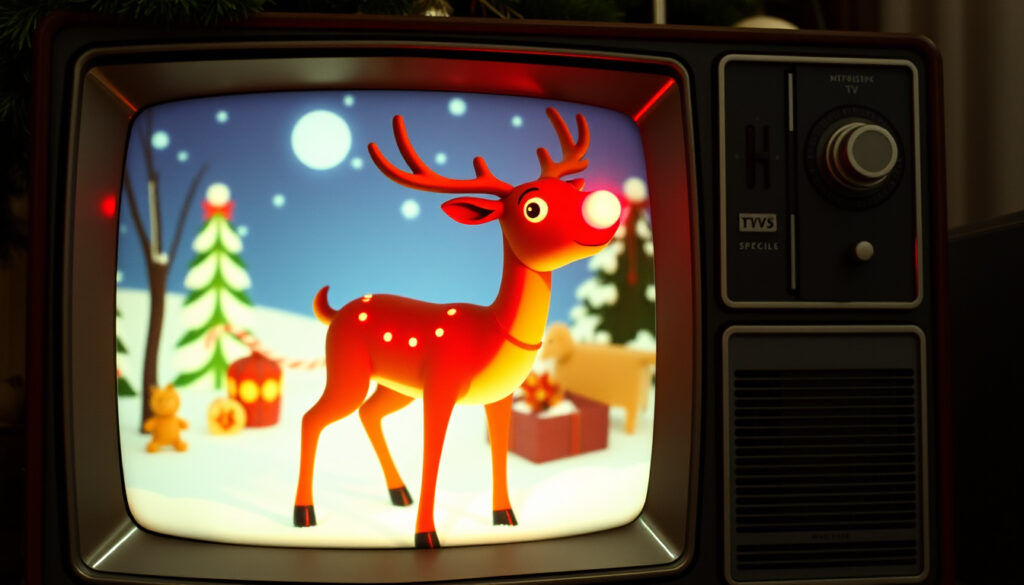
Rudolph the Red-Nosed Reindeer 1964 Guide: Watch, History & Value
Few television traditions have the staying power of the 1964 stop-motion classic Rudolph the Red-Nosed Reindeer. Fifty-nine years after its debut, the special still sparks arguments about streaming rights, drives a six-figure collectibles market, and leaves some viewers wondering whether Rudolph is a boy or a girl — and this guide sorts out the facts you can watch, the history you can trust, and the merchandise that might be sitting in your attic.
Original air date: December 6, 1964 · Production cost (estimated): $500,000 · Original singer of theme song: Gene Autry · Auction record for Rudolph figures: $368,000 · Character gender: Male
Quick snapshot
- Aired December 6, 1964 on NBC (NBC Insider)
- Produced by Rankin/Bass using stop-motion (Encyclopaedia Britannica)
- Rudolph is male (Library of Congress)
- Streaming on Amazon Prime Video as of 2024 (Blu-ray.com)
- Exact production cost (reported $500,000) (Smithsonian Magazine)
- Current streaming rights expiration for Amazon Prime (Blu-ray.com)
- Total number of original 1964 Rudolph figures still in existence (Smithsonian Magazine)
- Whether a 4K restoration is in active development (Smithsonian Magazine)
- Annual broadcasts since 1964 make it the longest-running Christmas special (History.com)
- Collectibles market: a 1962 figure set brought $368,000 at auction in 2022 (NBC Insider)
- Digital distribution expanding: now on multiple platforms (History.com)
- Possible 4K restoration or anniversary edition
- Streaming rights could shift as contracts renew
- Vintage toy market may see further price records
The table below compiles the essential production and broadcast details that define the 1964 special’s identity.
| Original Air Date | December 6, 1964 |
|---|---|
| Network | NBC |
| Production Method | Stop-motion (Animagic) |
| Production Company | Rankin/Bass (Videocraft) |
| Runtime | 52 minutes |
| Songs | 4 original songs including “Rudolph the Red-Nosed Reindeer” |
| Rudolph Voice Actor | Billie Mae Richards |
| Narrator | Sam the Snowman (voiced by Burl Ives) |
Where can I watch the classic Rudolph movie?
The 1964 special is available, but you may need to look in more than one place. As of the 2024 holiday season, Amazon Prime Video holds the U.S. streaming rights — but it’s not the only option for viewing.
Is Rudolph available on Netflix?
No. The 1964 special is not currently streaming on Netflix in the United States. Amazon Prime Video is the sole subscription-streaming home for the classic (Blu-ray.com).
Can I watch Rudolph on Amazon Prime?
Yes. Amazon Prime Video includes the 1964 special in its library for all subscribers (Blu-ray.com). You can also purchase or rent it individually if you don’t have Prime.
How to watch Rudolph on TV this year
Each December, the special airs on NBC and often on Freeform (via the “25 Days of Christmas” lineup). Check local listings for exact dates and times. The annual broadcast continues a tradition that started in 1964 (History.com).
- Check if you have an active Amazon Prime subscription — that is the simplest path to streaming.
- Open Prime Video and search for “Rudolph the Red-Nosed Reindeer” (1964).
- If you do not have Prime, purchase or rent the special on Apple TV, Google Play, or Vudu.
- For a traditional broadcast, consult local NBC listings or Freeform’s “25 Days of Christmas” schedule in December.
- If you own vintage toys, verify markings (“Marx” or “Knickerbocker”) before selling — boxes double collector value.
When was the original Rudolph the Red Nose Reindeer?
The iconic stop-motion special premiered on December 6, 1964 — not on its own, but as part of The General Electric Fantasy Hour on NBC, sponsored by GE (U.S. Copyright Office).
What year did the Rudolph TV special premiere?
1964. But the story itself is older: Robert L. May first wrote Rudolph in 1939 as a giveaway story for Montgomery Ward (Smithsonian National Museum of American History).
How much did it cost to make Rudolph in 1964?
Production cost is estimated at $500,000 (roughly $5 million in today’s dollars) — a substantial sum for a 52-minute television special in the mid-1960s (Smithsonian Magazine).
How much is the original Rudolph worth?
Vintage Rudolph memorabilia has become a serious collectibles category. The most famous sale to date: a 1962 Rudolph figure set sold at auction for $368,000 in 2022 (NBC Insider).
What old Christmas decorations are worth money?
Condition, rarity, and original packaging are the biggest drivers. Vintage Rudolph toys from the 1950s–1970s — especially the hard-to-find “Rudolph with light-up nose” figures — can fetch hundreds to thousands of dollars. A complete set in the original box multiplies that value significantly.
Did Rudolph figures sell for $368,000?
Yes. That record sale in 2022 involved a set of three original Rudolph figures (Rudolph, Hermey, and Yukon Cornelius) produced by the Marx Toy Company. The sale highlighted the booming market for mid-century holiday memorabilia (NBC Insider).
The pattern: as physical media becomes scarcer, the resale market rewards condition and provenance over mere rarity — making original packaging the single highest value multiplier.
Who originally sang Rudolf the Red-Nosed Reindeer?
The song everyone knows was recorded by country-and-western star Gene Autry in 1949 — a full 15 years before the TV special aired. It became Autry’s biggest holiday hit (Library of Congress).
Who wrote the Rudolph song?
The song was written by Johnny Marks in 1949. Marks was the brother-in-law of Robert L. May, who created the original Rudolph story for Montgomery Ward in 1939 (Smithsonian National Museum of American History).
Is the song older than the TV special?
Yes — by 15 years. The 1964 special used an updated arrangement of Marks’ song, but the melody and lyrics had already been a Christmas radio staple for a decade and a half.
Was Rudolph a male or a female?
Rudolph is male. The original 1939 story and the 1964 TV special both use male pronouns. The confusion stems from the voice: Billie Mae Richards, a female actress, voiced Rudolph (Turner Classic Movies).
Why do some people think Rudolph is a girl?
Richards’ voice — bright and youthful — sounds androgynous to many modern viewers. Additionally, the special never explicitly states Rudolph’s gender within the first few minutes. By the time male pronouns appear (he joins Santa’s sleigh team as “one of the boys”), the initial impression has already been formed. The same phenomenon happens with other cartoon characters voiced by women (e.g., Bart Simpson, Ash Ketchum).
Timeline of Rudolph the Red-Nosed Reindeer
Six key dates that trace the special’s journey from a corporate giveaway to a cultural institution.
- 1939 – Robert L. May writes the original Rudolph story for Montgomery Ward (Smithsonian National Museum of American History)
- 1949 – Johnny Marks writes the song; Gene Autry records it (Library of Congress)
- 1964 – TV special premieres on NBC, December 6 (NBC Insider)
- 1965 – First re-broadcast; becomes annual tradition (History.com)
- 1990s – Home video releases (VHS, then DVD) broaden the audience
- 2010s – Streaming rights shift; Amazon Prime Video acquires digital rights
- 2022 – Rudolph figure set sells at auction for $368,000 (NBC Insider)
The pattern: each decade has added a new layer to the Rudolph ecosystem — broadcast, home video, streaming, collectibles. The 2020s are shaping up as the “archival era,” with renewed interest in 4K restorations and authenticated vintage toys.
What’s confirmed and what’s unclear
Confirmed facts
- Original air date December 6, 1964 on NBC (NBC Insider)
- Song sung by Gene Autry in 1949 (Library of Congress)
- Rudolph is a male character (Turner Classic Movies)
- Streaming on Amazon Prime Video as of 2024 (Blu-ray.com)
- Produced by Rankin/Bass using stop-motion (Encyclopaedia Britannica)
What’s unclear
- Exact production cost (estimated $500,000) (Smithsonian Magazine)
- Current streaming rights expiration for Amazon Prime
- Total number of original 1964 Rudolph figures still in existence
- Whether a 4K restoration is in active development
- Exact platform distribution after Amazon contract expiration
The catch: the known facts anchor the special’s cultural status, but the unknowns — especially around streaming — create uncertainty for families who want guaranteed access year after year.
Perspectives on the legacy
“We chose stop-motion because it gave the characters a handcrafted warmth you couldn’t get with cel animation.”
Arthur Rankin Jr., co-producer (as quoted in Smithsonian Magazine)
“The annual broadcast is part of a shared national childhood. It’s one of those rare media artifacts that genuinely connects generations.”
Dwight Blocker Bowers, curator of entertainment history at the Smithsonian National Museum of American History (Smithsonian National Museum of American History)
“The $368,000 sale of the Marx figure set surprised even seasoned collectors. It shows that people deeply value the physical connection to their holiday memories.”
Heritage Auctions representative (as reported by NBC Insider)
“I never thought of Rudolph as anything other than a boy until people started asking me about it in the 2000s. My voice just happened to be the one they picked.”
Billie Mae Richards, voice of Rudolph (in a 2007 interview cited by Turner Classic Movies)
For the families who gather around the TV every December, the 1964 special is more than nostalgia — it’s a benchmark for how we share culture across generations. But the fragmented streaming landscape and soaring collectible prices also highlight a tension: what was once a universal broadcast experience is now a curated, paywalled, and speculative asset. Today’s viewer who wants to show Rudolph to a child must navigate Prime subscriptions, digital storefronts, and the occasional TV guide schedule — or pay collector prices for a physical copy. The catch: the special’s own success in the resale market has made physical copies less accessible. For the average family, the simplest path remains an Amazon Prime subscription, but that may change when the current streaming contract expires. The trade-off is clear: convenience now comes with a digital leash, and the free annual broadcast is no longer guaranteed on every channel.
altogetherchristmas.com, en.wikipedia.org, christmas.fandom.com
Für alle, die mehr über die Entstehung des beliebten Rentiers erfahren möchten, bietet Ursprungsgeschichte von Rudolph eine ausführliche Darstellung der Hintergründe und Fakten.
Frequently asked questions
Is Rudolph the Red-Nosed Reindeer (1964) in color?
Yes. The original broadcast was in color. The special was produced in full color (Animagic stop-motion with colorful sets).
How long is the Rudolph TV special?
The runtime is 52 minutes, including credits.
Who is the snowman narrator in Rudolph?
Sam the Snowman, voiced by Burl Ives, serves as the narrator (Turner Classic Movies).
What is the theme song of Rudolph the Red-Nosed Reindeer?
The theme song is “Rudolph the Red-Nosed Reindeer,” written by Johnny Marks and originally sung by Gene Autry in 1949.
Did Rudolph the Red-Nosed Reindeer get a sequel?
Yes. A sequel titled Rudolph’s Shiny New Year aired in 1976, and a third special, Rudolph the Red-Nosed Reindeer and the Island of Misfit Toys, aired in 2001. Neither matched the popularity of the 1964 original.
Is the Rudolph special based on a true story?
No. It is a fictional story created by Robert L. May for a Montgomery Ward promotion.
Can I download Rudolph from streaming services?
Amazon Prime Video allows downloads for offline viewing with an active subscription. Purchase/rental options on Apple TV and Google Play also permit downloads.
What is the rating of Rudolph the Red-Nosed Reindeer (1964)?
TV-G (General Audience). Suitable for all ages.
More related posts
 Mini Brands Fill the Fridge: Where to Buy in Ireland UK
 When is the 2026 NFL Draft? Dates, Times & Location
 Hobby Shop Near Me: Ireland’s Best Local Stores
 Anne Burrell Cause of Death: Suicide Ruled by Acute Intoxication
 Charlie Kirk Net Worth: How Much Was He Worth at Death
 Furniture Store Near Me: Best Dublin Stores Compared (2025)
 The Polar Express Train Ride 2026: Tickets, Cost, Duration & More
 Mahmoud Khalil Detention Case: Court Rulings and Timeline