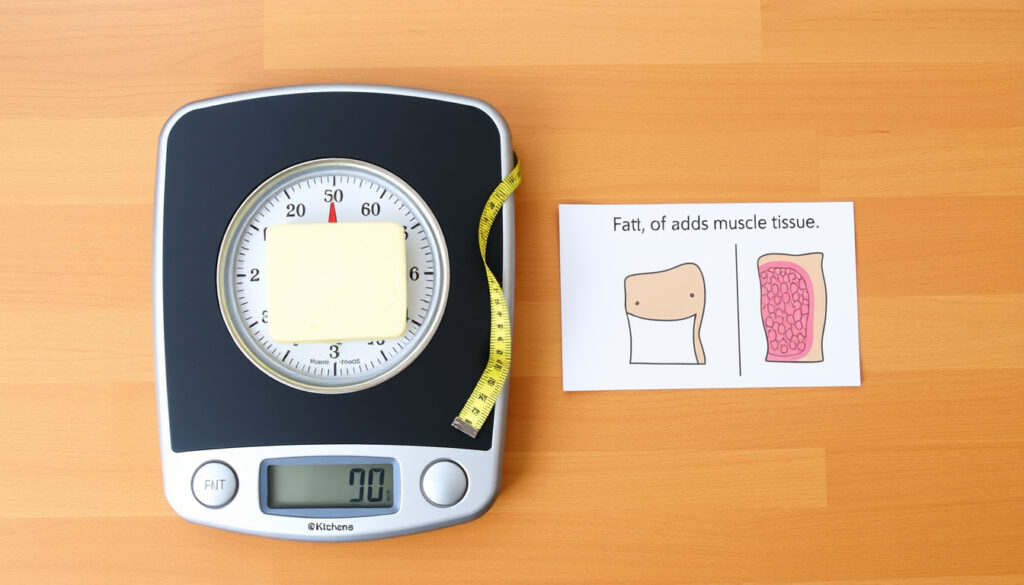
How Many Calories in a Pound? Fat, Muscle, and Weight Loss Myth
You’ve probably heard the rule: cut 3,500 calories and you’ll lose a pound. It’s been repeated in textbooks and health websites for decades. But modern research, including a 2014 analysis in PubMed Central (peer-reviewed database), shows the actual energy in a pound of body fat is closer to 3,750 calories — and that weight loss is far more complex than a single number. This article explains why the old rule is outdated and what you should know about creating a real calorie deficit.
Calories in 1 lb of fat (old rule): 3,500 ·
Calories in 1 lb of fat (modern estimate): 3,436–3,752 ·
Daily deficit for 1 lb/week: 500 ·
Daily deficit for 2 lb/week: 1,000
Quick snapshot
- Old rule: 3,500 calories (Mayo Clinic (health system))
- Modern range: 3,436–3,752 (Healthline (specialist publisher))
- Adipose tissue: ~3,750 kcal (PubMed Central (peer-reviewed database))
- 500 deficit = ~1 lb/week (MedlinePlus (U.S. National Library of Medicine))
- 1,000 deficit = ~2 lb/week (University Hospitals (academic medical center))
- Individual factors vary (Harvard Health (university-affiliated publisher))
- The 3,500 rule is oversimplified (American Institute for Cancer Research (research organization))
- Weight loss is not all fat (Today’s Dietitian (professional nutrition journal))
- Muscle loss can skew math (UT MD Anderson Cancer Center (comprehensive cancer center))
- Focus on whole foods (WebMD (health information publisher))
- Best: protein, fiber (Harvard Health)
- Exercise and sleep matter (UT MD Anderson Cancer Center)
Five key facts summarize the energy content of body fat and the deficit needed for weight loss:
| Fact | Value |
|---|---|
| Caloric content of 1 lb pure fat | 3,500–3,752 calories |
| Caloric content of 1 lb adipose tissue | ~3,750 calories |
| Calories in 1 lb muscle | 600–700 calories |
| Typical steps to burn 500 calories | ~10,000 steps |
| Safe weekly weight loss rate | 1–2 pounds |
How many calories are in a pound of fat?
Why the 3,500-calorie rule is oversimplified
The 3,500-calorie-per-pound rule traces back to 1958 work associated with Max Wishnofsky (Today’s Dietitian (professional nutrition journal)). His estimate was based on the idea that human adipose tissue is about 87% fat, which yields about 3,500 calories per pound of fat tissue (Birmingham Digestive Disease Center (gastroenterology clinic)).
Modern analyses say the 3,500-calorie rule significantly overestimates weight loss over time (PubMed Central (peer-reviewed database)). The body adapts to reduced calorie intake by lowering energy expenditure, which slows real-world weight loss (UT MD Anderson Cancer Center (comprehensive cancer center)).
The 3,500 rule is a useful classroom example, but for the average dieter it sets unrealistic expectations because it ignores metabolic adaptation.
How researchers estimate actual energy in adipose tissue
A pound of body fat may contain roughly 3,436 to 3,752 calories depending on assumptions about fat composition (Healthline (specialist publisher)). Another published estimate places a pound of body fat in a similar range of roughly 2,843 to 3,752 calories (Zoë Harcombe (public health nutrition researcher)).
- Adipose tissue energy content is approximately 3,750 kcal (PubMed Central).
- One pound of body weight is often approximated as 454 grams (MedlinePlus (U.S. National Library of Medicine)).
Calories in muscle vs. fat
Muscle contains far fewer calories per pound — between 600 and 700 — compared with fat’s 3,500+ calories (Healthline). This difference matters because when you lose weight, the composition of what you lose (fat vs. muscle) changes the actual calorie deficit required.
How many calories do I need to burn to lose 1 pound?
The 500-calorie deficit rule
A 500-calorie-per-day deficit is commonly described as a rough guide that may produce about 1 pound of weight loss per week in the short term (MedlinePlus). WebMD states that a 500-calorie daily deficit is a general rule of thumb for about 1 pound per week (WebMD (health information publisher)).
Why individual factors change the math
The 3,500-calorie formula is often explained as a historical approximation rather than a biologically exact figure (NutritionFacts.org (public health resource)). Metabolism, body composition, and activity level affect actual results. Harvard Health says many programs recommend losing no more than 1 to 2 pounds per week for sustainability (Harvard Health (university-affiliated publisher)).
Using a calorie deficit calculator
A calorie deficit means burning more calories than you consume (UT MD Anderson Cancer Center). University Hospitals says subtracting 500 to 1,000 calories from your total daily energy expenditure (TDEE) may help most people lose about 0.5 to 2 pounds per week (University Hospitals (academic medical center)).
The pattern: a fixed 500-calorie cut works as a starting point, but dynamic models that account for metabolic slowdown give a more realistic long-term forecast.
How to lose 2 pounds a week?
Creating a 1,000-calorie daily deficit
A 1,000-calorie daily deficit can lead to about 2 pounds lost per week. Sustainable weight loss is typically 1–2 pounds per week (Mayo Clinic (leading health system)).
Combining diet and exercise
To reach a 1,000-calorie deficit safely, combine dietary cuts with increased physical activity. The body adapts to reduced intake by lowering energy expenditure (UT MD Anderson Cancer Center), so exercise helps offset metabolic slowdown.
- Calculate your Total Daily Energy Expenditure (TDEE). Use an online calculator to estimate your baseline calorie needs.
- Set a 1,000-calorie deficit. Subtract 1,000 calories from your TDEE to set your daily calorie target.
- Split the deficit between diet and exercise. Aim to cut 500 calories from food and burn 500 calories through activity, such as walking 10,000 steps.
- Monitor weekly progress and adjust. Track weight and energy levels, modifying intake or exercise as your body adapts.
- 10,000 steps burn about 300–500 calories for most people (MedlinePlus).
Risks of too-rapid weight loss
Extreme deficits can cause muscle loss, nutrient deficiencies, and metabolic slowdown. The common 3,500-calorie-per-week advice is not necessarily accurate over time (Mayo Clinic (leading health system)). Losing more than 2 pounds per week is generally not recommended without medical supervision.
For someone aiming for 2 pounds per week, the risk of muscle loss and fatigue rises sharply. A slower pace often preserves lean mass and leads to better long-term results.
The trade-off mentioned above highlights why a moderate, sustainable deficit is generally more effective than an aggressive cut.
What kills belly fat naturally?
Foods that increase belly fat
Refined carbohydrates, sugary drinks, and trans fats are strongly linked to belly fat gain. For example, a meal like Chick-fil-A Nuggets: Prices, Calories, Sizes & Diabetes shows how easily calories and unhealthy fats can add up in fast food. The 3,500-calorie rule can be misleading because it assumes everyone loses weight at the same rate after the same calorie cut (American Institute for Cancer Research (research organization)). A diet rich in protein and fiber helps reduce cravings and supports fat loss (Harvard Health).
The role of sleep and stress
Inadequate sleep and high stress increase cortisol, which promotes visceral fat storage. Adequate rest is a key component of any fat-loss plan (WebMD (health information publisher)).
Exercise that targets visceral fat
Aerobic exercise and resistance training both reduce visceral fat. Understanding your cardiovascular fitness, as explained in What Is VO2 Max? Definition, Norms, and How to Improve It, can help tailor your workout for maximum fat burn. A 1,000-calorie daily deficit from diet plus exercise can help, but spot reduction is a myth — you cannot lose fat from one area specifically (Harvard Health).
What this means: there is no single “belly fat killer.” The most effective approach is a consistent calorie deficit combined with whole foods, sleep, and movement.
Which body part loses fat first?
Genetics and fat storage
Fat loss order is determined by genetics and hormones. The 3,500-calorie rule appears in many textbooks and health websites even after being challenged by newer models (Healthline (specialist publisher)), partly because it’s a simple story. But genetics dictate where you store and lose fat first.
Why spot reduction is a myth
You cannot target fat loss from a specific area. Doing hundreds of crunches will not reduce belly fat faster. A more accurate approach uses dynamic models that account for metabolic adaptation instead of a fixed calories-per-pound conversion (PubMed Central (peer-reviewed database)).
How men and women differ
Men typically lose fat from the abdomen first; women from hips and thighs, due to hormonal differences (Healthline). The implication is that patience is key: where you lose fat first is largely out of your control.
The catch: while you can’t choose the order, you can control the overall rate of fat loss through a sustained calorie deficit.
Confirmed facts
- Muscle contains far fewer calories than fat per pound (Healthline).
What’s unclear
- A pound of body fat contains roughly 3,500–3,750 calories (Healthline).
- A 500-calorie daily deficit leads to about 1 pound weight loss per week on average (MedlinePlus).
- Exactly how many calories each individual will need to burn to lose 1 pound (varies by metabolism).
- Whether the 3,500 rule ever applied to real-world weight loss across all body types (PubMed Central notes the rule oversimplifies).
Expert perspectives
The 3,500-calorie-per-pound rule is a rule of thumb, not a precise law of human weight loss.
PubMed Central (peer-reviewed database)
A 500-calorie-per-day deficit is a rough guide that may produce about 1 pound of weight loss per week in the short term.
MedlinePlus (U.S. National Library of Medicine)
The 3,500-calorie rule can be misleading because it assumes everyone loses weight at the same rate after the same calorie cut.
American Institute for Cancer Research (research organization)
For the average dieter, the choice is clear: focus on a consistent 500- to 750-calorie deficit based on your own total daily energy expenditure, rather than chasing the old 3,500 number, or risk frustration when real-world results don’t match the textbook math.
Frequently asked questions
Is it true that you burn 3,500 calories to lose a pound?
As a rough guide, yes, but modern research shows metabolic adaptation means actual results vary (PubMed Central).
How many calories does a child need to burn to lose a pound?
The same 3,500-calorie approximation applies per pound of fat, but children have different metabolic rates and should never follow adult calorie-restricted diets without medical guidance.
How many calories are in a pound of muscle compared to fat?
Muscle contains about 600–700 calories per pound, far less than fat’s 3,500+ (Healthline).
Can I lose 2 pounds a week safely?
Yes, with a 1,000-calorie daily deficit, but sustainable loss is typically 1–2 pounds per week (Mayo Clinic).
How many calories do 10,000 steps burn?
About 300–500 calories for most people, depending on body weight and walking speed (Harvard Health).
What foods should I avoid to lose belly fat?
Refined carbs, sugary drinks, and trans fats are strongly linked to belly fat gain. Focus on protein, fiber, and whole foods (Harvard Health).
More related posts
 What Do Mice Eat? Complete Guide to Mouse Diet & Food Sources
 What Is the Weather Tomorrow? Dublin & Ireland Forecast
 Words That Start With I: Complete List & Meanings for Kids
 What Actor Died Today? Recent Celebrity Death & Obituarie
 Who’s Playing Football Tonight? TV Schedule & Live Matches
 Rings of Power Season 2 Release Date
 Samsung Galaxy Buds 3 Pro Review: Worth Buying in 2025?
 When Is iPhone 17 Coming Out? Release Date & Price