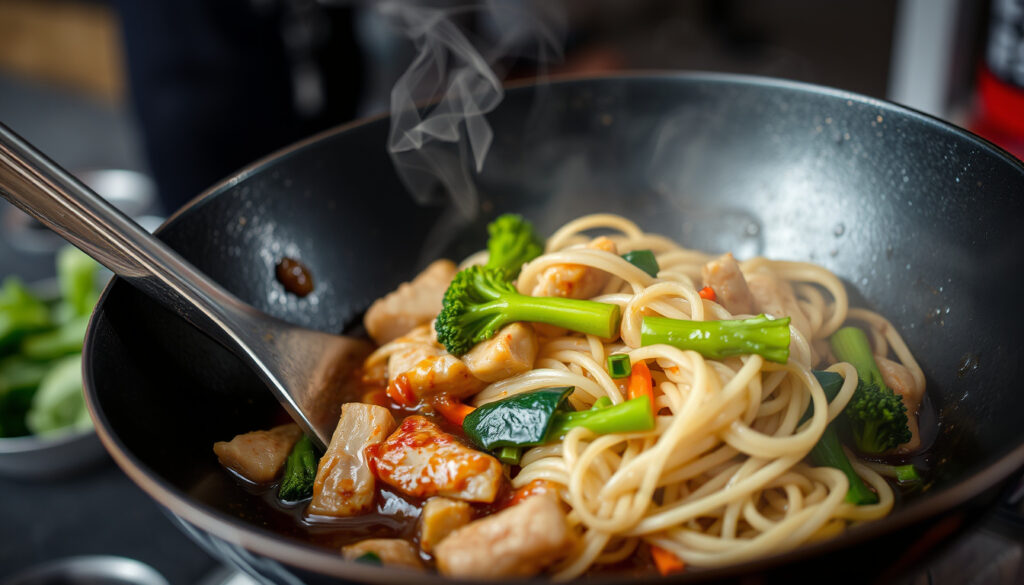
Pad See Ew Recipe: Authentic Thai Stir-Fried Noodles
Anyone who’s ordered pad see ew from a Thai restaurant knows the pull of those chewy, caramelized noodles. The version you make at home can be just as rewarding — if you start with the right soy sauce.
Prep Time: 15 minutes ·
Cook Time: 10 minutes ·
Servings: 2–3 ·
Calories per Serving: ~450 kcal ·
Difficulty: Medium ·
Popularity: Top Thai street food
Quick snapshot
- Traditional noodle is sen yai (wide fresh rice noodles) (BBC Good Food)
- Dark soy sauce provides the signature color and sweetness (RecipeTin Eats)
- Chinese broccoli (gai lan) is the standard vegetable (Eating Thai Food)
- Exact calorie count varies significantly with protein choice and oil quantity (BBC Good Food)
- Glycemic impact depends on noodle preparation method and individual metabolism (BBC Good Food)
- Some recipes include fish sauce; others omit it (BBC Good Food includes it)
- Prep: 15 minutes · Cook: 10 minutes — total 25 minutes
- Noodles soak 20–30 minutes if using dried sen yai
- High-heat stir-fry: 2–3 minutes per batch
- Serve immediately — the noodles tighten as they cool
- Store leftovers in an airtight container for up to 2 days
- Reheat in a wok or skillet, not a microwave
Here are the key facts about pad see ew summarized.
| Attribute | Value |
|---|---|
| Typical Noodle Type | Sen Yai (wide fresh rice noodles) |
| Key Flavoring | Dark soy sauce |
| Common Protein | Pork, chicken, beef |
| Average Calories | 450 kcal per serving |
| Prep Time | 15 minutes |
| Cook Time | 10 minutes |
What are the ingredients for pad see ew?
Essential proteins
- Pork (sliced shoulder or loin) — the most common protein in Thailand
- Chicken thigh — stays juicy under high heat
- Beef (sirloin or flank) — sliced thin against the grain
- Tofu (firm, pressed) — for vegetarian versions
The protein is typically marinated briefly with a splash of soy sauce and white pepper before stir-frying. RecipeTin Eats notes that the protein should be cooked first and removed from the wok before the noodles go in (RecipeTin Eats).
Vegetables
- Chinese broccoli (gai lan) — thick stems and leafy greens, the authentic choice
- Substitute: broccoli rabe or regular broccoli if gai lan is unavailable
- Some recipes add carrot or bell pepper for color, though these are not traditional
The Woks of Life explains that the stems are sliced diagonally and the leaves are left whole for texture contrast (The Woks of Life).
Noodles
- Sen yai (fresh wide rice noodles) — about ¾ inch wide, chewy texture
- Dried wide rice noodles — soak in warm water 20–30 minutes until pliable, then drain
- Fresh noodles can be found in Asian grocery stores; they need only a quick rinse in warm water to separate
Eating Thai Food emphasizes that the noodles should be loosened before they hit the wok, or they’ll clump into a sticky mass (Eating Thai Food).
Seasonings
- Dark soy sauce — for color and a hint of sweetness
- Oyster sauce — the main umami driver
- Fish sauce — adds saltiness and depth (optional in some Western versions)
- Sugar — balances the salty and savory elements
- White pepper — a subtle heat that’s distinct from black pepper
- Rice vinegar or white vinegar — a brief sour note to lift the sauce
The signature flavor profile is sweet-savoury, with dark soy sauce used largely for color and oyster sauce providing much of the main taste, according to RecipeTin Eats (RecipeTin Eats).
The range of ingredients is small, but each component plays a specific role in the final dish.
What sauce is best for pad see ew?
Dark soy sauce role
- Dark soy sauce is thicker, sweeter, and less salty than light soy sauce
- It’s responsible for the deep brown-black color that defines pad see ew
- Thai black soy sauce (si-ew dam) is the closest authentic match
- Mushroom soy sauce can be used as a vegetarian substitute
Eating Thai Food identifies dark sweet soy sauce as a key part of an authentic formulation (Eating Thai Food).
Oyster sauce vs. soy sauce
- Oyster sauce delivers the primary savory (umami) backbone of the dish
- Light soy sauce adds saltiness but is not the main flavoring agent
- Fish sauce is used by some recipes (including BBC Good Food’s) for an extra layer of salinity (BBC Good Food)
- Simply Suwanee’s version adds soybean paste and rice wine vinegar for complexity (Simply Suwanee)
The balance is a 2:1 ratio of oyster sauce to dark soy sauce, with a teaspoon of sugar and a splash of vinegar, according to many home-cook recipes.
Homemade sauce recipe
- 2 tbsp dark soy sauce — for color and sweetness
- 1 tbsp oyster sauce — for umami
- 1 tsp fish sauce (or salt, for vegetarian) — for saltiness
- 1 tsp sugar — to balance
- 1 tsp rice vinegar — for a lifting sour note
- ¼ tsp white pepper — for subtle heat
A common home-cook method is to mix the sauce separately before stir-frying the noodles, whisking until the sugar dissolves. Feasting At Home’s recipe includes soy sauce, oyster sauce, dark sweet soy sauce, fish sauce, rice wine vinegar, white pepper, and sugar or a substitute sweetener (Feasting At Home).
The sauce is the dish’s defining element. Without dark soy sauce, pad see ew becomes a pale, soupy noodle stir-fry. With it, you get the caramelized, glossy strips that make the dish recognisable.
The sauce composition must be intense enough to coat the noodles without overwhelming them.
What is the difference between pad see ew and Pad Thai?
Noodle types
- Pad See Ew uses sen yai (wide fresh rice noodles, about ¾ inch wide)
- Pad Thai uses sen chan (thin rice noodles, about ⅛ inch wide)
- Pad See Ew noodles are chewy and caramelized; Pad Thai noodles are softer and more delicate
The Woks of Life notes that the wide noodles in pad see ew are better suited for high-heat searing that creates the coveted charred edges (The Woks of Life).
Sauce profiles
- Pad See Ew sauce is soy-based (dark soy, oyster sauce, fish sauce) — savory and slightly sweet
- Pad Thai sauce is tamarind-based (tamarind paste, fish sauce, sugar, chili) — sour, salty, and sweet
- Pad See Ew relies on caramelization; Pad Thai relies on the raw sauce coating the noodles
Carlsbad Cravings notes that authentic pad see ew is typically made with Thai sweet soy sauce and dark soy sauce along with oyster sauce, vinegar, and sugar (Carlsbad Cravings).
Flavor profile
- Pad See Ew is bolder, saltier, and more umami-driven with a charred, smoky aroma
- Pad Thai is brighter, more acidic, and often includes textural toppings (peanuts, bean sprouts, lime)
- Pad See Ew is typically served without garnish; Pad Thai is served with a wedge of lime and crushed peanuts
The trade-off is that pad see ew is simpler in ingredients but harder to execute well because the wok hei (smoky wok breath) is essential.
Six contrasts, one pattern: pad see ew is a more restrained, ingredient-focused dish — fewer components, higher technique — while Pad Thai is a layered, garnish-heavy crowd-pleaser.
| Attribute | Pad See Ew | Pad Thai |
|---|---|---|
| Noodle type | Wide rice noodles (sen yai) | Thin rice noodles (sen chan) |
| Sauce base | Soy sauce + oyster sauce | Tamarind + fish sauce |
| Primary flavor | Savory, umami, slightly sweet | Sour, salty, sweet |
| Key technique | High-heat sear for caramelization | Coating noodles in sauce |
| Toppings | None (or chili flakes) | Peanuts, bean sprouts, lime |
| Protein style | Stir-fried with noodles | Often stir-fried separately |
How to make pad see ew taste better?
Achieving wok hei
- Use a wok (carbon steel preferred) over the highest heat your stove produces
- Work in small batches — overcrowding drops the temperature and steams the noodles
- Let the noodles sit undisturbed for 30–45 seconds after adding them to the wok to develop a char
- The Big Man’s World recipe emphasizes leaving noodles undisturbed briefly to caramelize before tossing (The Big Man’s World)
Hot Thai Kitchen (Pailin Chongchitnant) explains that high heat is key to achieving the smoky wok hei flavor in pad see ew. Without it, the dish becomes a bland, soggy noodle plate.
Proper noodle prep
- Fresh noodles: rinse under warm water and gently separate each strand. Pat dry with paper towels
- Dried noodles: soak in warm (not hot) water until pliable but still firm — over-soaking makes them mushy
- Drain thoroughly before adding to the wok; excess water kills the sear
- Toss the noodles with a teaspoon of oil after draining to prevent sticking
Thai-Foodie’s version uses dark soy sauce, mushroom soy sauce, oyster sauce, and sugar, and stresses that the noodles must be dry before hitting the wok (Thai-Foodie).
Balancing flavors
- Taste the sauce before adding it to the wok — it should be more intense than you think, because the noodles will dilute it
- Add a pinch of sugar if the sauce tastes too salty; add a splash of vinegar if it’s too sweet
- White pepper provides a subtle warmth that black pepper doesn’t — it’s the traditional choice
The Woks of Life uses white pepper as the seasoning pepper in its pad see ew recipe, noting that it’s the standard in Thai kitchens (The Woks of Life).
Wok hei is difficult to replicate on a home electric stove. The best workaround: use a portable butane burner outdoors, or preheat your wok until it just starts to smoke before adding oil.
Mastering wok hei is the difference between good and great pad see ew.
Is pad see ew healthy for weight loss?
Calorie content
- Average serving: ~450–550 kcal depending on protein and oil quantity
- A single serving of wide rice noodles alone contributes ~200–250 kcal
- Oil used in stir-frying adds 100–150 kcal per tablespoon
The exact calorie count varies significantly with protein choice and oil quantity, so portion awareness matters more than the dish’s base ingredients.
Nutritional profile
- High in carbohydrates (50–60 g per serving from noodles)
- Moderate protein (15–25 g depending on protein portion)
- Low in fiber unless extra vegetables are added
- Can be high in sodium (800–1200 mg) due to soy sauce and oyster sauce
For someone with diabetes, the glycemic load is a concern. The white rice noodles have a high glycemic index, and portion control is critical. Using fewer noodles and adding more vegetables can help.
Portion control tips
- Use half the noodles and double the vegetables
- Choose lean protein (chicken breast, tofu) instead of pork belly or beef
- Limit oil to 1 tablespoon total
- Use reduced-sodium soy sauce and check oyster sauce labels for added sugar
A typical restaurant serving of pad see ew can exceed 700 kcal because of generous oil and sugar. The home-made version is easier to control, but the carb load remains substantial.
Portion control and vegetable additions can make pad see ew more diet-friendly.
Upsides
- Quick to cook (25 minutes total) — faster than takeout
- Customizable protein and vegetable options
- Rich umami flavor without needing many ingredients
- Can be made gluten-free by using tamari instead of soy sauce
- One-dish meal with protein, carbs, and vegetables
Downsides
- High in carbohydrates (~50–60 g per serving) — not ideal for low-carb diets
- Requires high heat and a wok for authentic results; hard to replicate on weak stoves
- Fresh wide rice noodles can be hard to find outside Asian grocery stores
- Easily becomes soggy if noodles are overcooked or overcrowded in the wok
- Calorie density can spike quickly with oil and sugar additions
Step-by-step: how to make pad see ew
- Prepare the sauce: In a small bowl, whisk together 2 tbsp dark soy sauce, 1 tbsp oyster sauce, 1 tsp fish sauce, 1 tsp sugar, 1 tsp rice vinegar, and ¼ tsp white pepper until the sugar dissolves.
- Prep the noodles: If using fresh sen yai, rinse under warm water and separate gently. Pat dry. If using dried noodles, soak in warm water for 20–30 minutes, then drain and toss with 1 tsp oil.
- Prep the protein and vegetables: Slice 150 g of protein (chicken, pork, beef, or tofu) into bite-sized pieces. Slice 2 stalks of Chinese broccoli diagonally, keeping stems and leaves separate.
- Stir-fry the protein: Heat a wok over high heat until smoking. Add 1 tbsp oil, then the protein. Cook for 1–2 minutes until browned. Remove and set aside.
- Stir-fry the vegetables: Add the broccoli stems first, stir-fry for 30 seconds. Add the leaves and cook for another 15 seconds. Remove and set aside.
- Cook the noodles: Add 1 tbsp oil to the wok. Add the noodles and spread them flat. Let them cook undisturbed for 30–45 seconds to develop a char. Then toss and repeat once more.
- Combine everything: Return the protein and vegetables to the wok. Pour the sauce over the noodles and toss everything together for 30–60 seconds until the sauce coats the noodles evenly.
- Serve immediately: Transfer to a plate. Optionally top with a sprinkle of white pepper and chili flakes. Do not let it sit — the noodles tighten as they cool.
The key is to work fast and keep the heat high. Every step from the moment the noodles hit the wok should take no more than 2–3 minutes total.
What’s confirmed and what’s not
Confirmed facts
- Pad see ew traditionally uses dark soy sauce for color and flavor (RecipeTin Eats)
- Authentic recipe includes Chinese broccoli (gai lan) (BBC Good Food)
- Wide rice noodles (sen yai) are the standard noodle (The Woks of Life)
- Oyster sauce provides the primary umami flavor (Eating Thai Food)
- High heat is essential for the signature caramelized char (The Big Man’s World)
What’s unclear
- Exact calorie count varies significantly with protein choice and oil quantity
- Glycemic impact depends on noodle preparation method and individual metabolism
- Whether fish sauce is essential — some authentic recipes include it, others don’t
- The precise vinegar-to-sugar ratio that yields the best balance is debated among home cooks
- Whether the dish can be authentically made without a wok remains disputed
What the experts say
High heat is key to achieving the smoky wok hei flavor in pad see ew.
— Pailin Chongchitnant, Hot Thai Kitchen
The soy sauce blend is the backbone of the dish’s savory profile.
— Serious Eats
Let the noodles sit undisturbed for 30–45 seconds — that’s where the caramelization happens.
— The Big Man’s World
Avoid overcrowding the wok. Cook in batches if you’re doubling the recipe.
— The Woks of Life
The difference between a good pad see ew and a great one comes down to two things: the sauce composition and the heat. Choose a dark soy sauce that’s thick and sweet, not just salty, and let your wok get hot enough to singe the noodles. For home cooks in the US or UK, the biggest hurdle is finding fresh sen yai noodles — but dried wide rice noodles work well if you soak them right. The choice is clear: invest in a carbon steel wok and a bottle of Thai dark soy sauce, or settle for a pale imitation.
Frequently asked questions
Can I use chicken instead of pork in pad see ew?
Yes. Chicken thigh is the preferred cut because it stays moist under high heat. Slice it thin and marinate briefly with a splash of soy sauce before cooking.
What type of noodles are best for pad see ew?
Fresh sen yai (wide rice noodles) are the traditional choice. If unavailable, dried wide rice noodles (sometimes labeled “rice sticks” or “pad thai noodles” but in the wide cut) work after soaking in warm water for 20–30 minutes.
How to store leftover pad see ew?
Store in an airtight container for up to 2 days. Reheat in a hot wok or skillet with a splash of water to loosen the noodles. Do not microwave — it turns the noodles gluey.
Can I make pad see ew gluten-free?
Yes. Use tamari or coconut aminos instead of soy sauce, and check that your oyster sauce is gluten-free (some brands contain wheat). Rice noodles are naturally gluten-free.
What is the best oil for stir-frying pad see ew?
A neutral oil with a high smoke point, such as avocado oil, grapeseed oil, or refined peanut oil. Avoid olive oil — it burns at high heat.
How to prevent noodles from sticking?
Make sure the noodles are dry before adding them to the wok. Toss them with a teaspoon of oil after draining. Also, do not overcrowd the wok — cook in batches if needed.
Can I add vegetables like carrots or bell peppers?
Yes, though they are not traditional. If you add them, slice them thinly and stir-fry briefly so they retain crunch. The dish will still taste good, but it won’t be strictly authentic.
More related posts
 Texas Rangers World Series Ring: 2023 Design, Price & Replicas
 Mahmoud Khalil Detention Case: Court Rulings and Timeline
 Target RedCard Login: Pay Bills, Check Balance & More
 Books by Charlie Kirk: Complete List & Recommendations
 The Maze Runner Actors: Full Cast, Accidents, and Future Movies
 How Old Is Charlie Woods? Age, Height, Family & Golf Career
 The Constitution of the United States – History, Articles, Amendments
 Ryan Gosling Plastic Surgery: Did He Go Under the Knife?