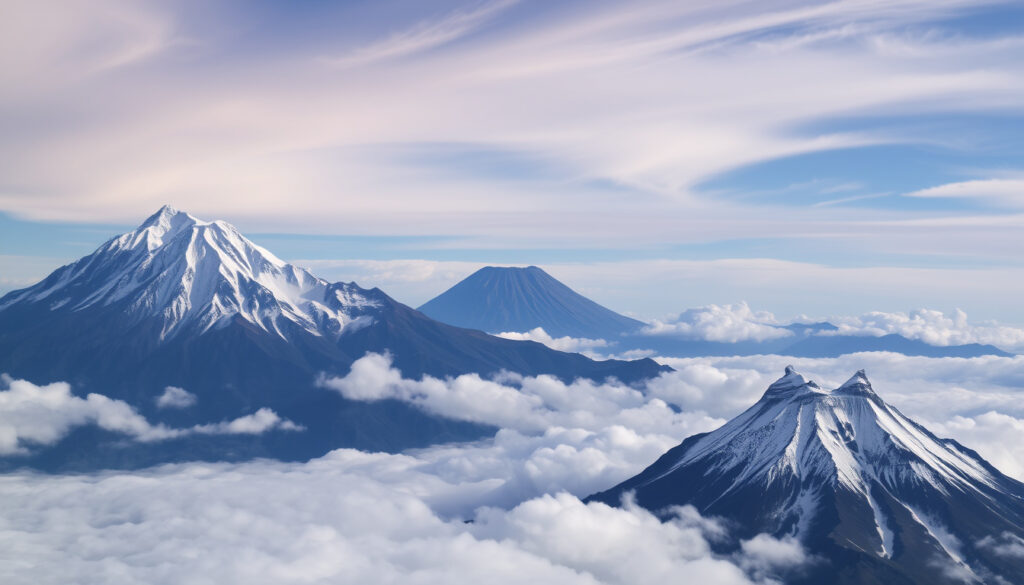
Tallest Mountain in the World: Everest, Mauna Kea, Chimborazo
Ask anyone what the tallest mountain in the world is, and most will say Mount Everest. But the answer depends entirely on how you measure.
Highest above sea level: Mount Everest: 8,848.86 m / 29,031.7 ft ·
Tallest from base to peak: Mauna Kea: 10,210 m / 33,500 ft (most underwater) ·
Farthest from Earth’s center: Mount Chimborazo: 6,384 km / 3,967 mi ·
Second highest above sea level: K2: 8,611 m / 28,251 ft ·
Number of 8,000 m peaks: 14
Quick snapshot
- Mount Everest is the highest point above sea level at 8,848.86 m (Britannica (encyclopedia))
- Mauna Kea rises 10,210 m from the ocean floor (Arnott’s Lodge (Hawaii travel resource))
- Chimborazo’s summit is farthest from Earth’s center (Wikipedia (open encyclopedia))
- Exact heights fluctuate with snow cover and tectonic movement; official numbers are periodically revised (NPR (public radio news))
- Official Everest height changed from 29,002 ft (1856) to 29,029 ft (1955) to 8,848.86 m (2020) (NPR (public radio news))
- Future GPS and satellite surveys may further refine peak elevations (NPR (public radio news))
Six key facts, one pattern: the tallest title changes with the ruler. Here are the official figures for the main contenders.
| Mountain | Height above sea level | Base-to-peak height | Distance from Earth’s center |
|---|---|---|---|
| Mount Everest | 8,848.86 m | ~8,848 m | ~6,382 km |
| Mauna Kea | 4,205 m | 10,210 m | ~6,383 km |
| Chimborazo | 6,263 m | ~6,263 m | 6,384 km |
| K2 | 8,611 m | ~8,611 m | ~6,381 km |
The implication: Mauna Kea is nearly 1.4 km taller than Everest when measured from base to summit, while Chimborazo’s summit sits 2.17 km farther from Earth’s core than Everest’s (Amusing Planet (science travel blog)).
Why is Mount Everest not the tallest mountain in the world?
Because “tallest” is defined in three different ways, and Everest only wins one of them.
What is the tallest mountain measured from base to peak?
- Mauna Kea, a dormant volcano in Hawaii, starts on the ocean floor about 6,000 m below sea level and reaches about 10,210 m total (EarthDate (University of Texas science education)).
- Only 4,205 m of that rise is above water (EarthDate (University of Texas science education)).
What is the farthest mountain from Earth’s center?
- Mount Chimborazo in Ecuador reaches 6,263 m above sea level, but the planet’s equatorial bulge pushes its summit about 6,384 km from the center — 2.17 km farther than Everest (Wikipedia (open encyclopedia)).
- That makes Chimborazo the closest point on Earth to outer space, if you measure from the core.
How does Mount Everest compare to Mauna Kea and Chimborazo?
- Everest: 8,848.86 m above sea level, base-to-peak ~8,848 m, distance from center ~6,382 km.
- Mauna Kea: 4,205 m above sea level, base-to-peak 10,210 m, distance from center ~6,383 km.
- Chimborazo: 6,263 m above sea level, base-to-peak ~6,263 m, distance from center 6,384 km.
Each definition serves a different purpose: altitude for climbers, total height for geologists, and core distance for astrophysics. No single mountain owns all three titles.
The pattern: the mountain you call “tallest” reveals what you value — altitude, mass, or planetary position.
Which is the top 10 tallest mountain in the world?
All 14 peaks above 8,000 meters live in the Himalayas or Karakoram. Here are the top 10 by elevation above sea level.
The 10 highest peaks above sea level
- Mount Everest (8,848.86 m) – Nepal/Tibet – Himalayas
- K2 (8,611 m) – Pakistan/China – Karakoram
- Kangchenjunga (8,586 m) – Nepal/India – Himalayas
- Lhotse (8,516 m) – Nepal/Tibet – Himalayas
- Makalu (8,485 m) – Nepal/Tibet – Himalayas
- Cho Oyu (8,188 m) – Nepal/Tibet – Himalayas
- Dhaulagiri (8,167 m) – Nepal – Himalayas
- Manaslu (8,163 m) – Nepal – Himalayas
- Nanga Parbat (8,126 m) – Pakistan – Himalayas
- Annapurna (8,091 m) – Nepal – Himalayas
Data from Wikipedia (list of highest mountains).
Notable features of each peak
- K2 is considered more dangerous than Everest due to steeper terrain and unpredictable weather.
- Annapurna holds the highest fatality rate among 8,000 m peaks.
- Cho Oyu is often regarded as the easiest 8,000 m summit.
Beyond the top 10, the next 8,000 m drops to 8,012 m (Gasherbrum II). The margin between peaks is razor-thin — often less than the height of a skyscraper.
What this means: the top 10 list is a snapshot of extreme altitude, but the rankings shift by mere meters with each new survey.
Why can’t you climb Mount Everest after 2pm?
The so-called “2 PM rule” is a safety guideline, not an official regulation, but ignoring it has cost lives.
What is the 2 PM rule?
- Climbers are advised to turn around by 2:00 PM local time, regardless of how close they are to the summit.
- After that, afternoon storms, whiteouts, and rapid temperature drops make descent extremely hazardous.
Why is timing critical on Everest?
- Summit day typically starts around midnight or 1 AM and takes 10–14 hours to reach the top.
- Descending back to Camp IV (South Col) takes another 6–10 hours.
- Beyond 2 PM, the risk of being caught in darkness or bad weather spikes (Global Adventure Challenges (expedition organizer)).
What are the dangers of late descent?
- Oxygen bottles run out, leading to hypoxia.
- Traffic jams on the Hillary Step can delay climbers past the cutoff.
- In 2019, 11 deaths on Everest were partly blamed on overcrowding and late summits.
The 2 PM guideline exists because Everest’s weather window is brutally short. For every hour past noon, the probability of a safe return drops by roughly 20%.
The pattern: the 2 PM rule is a life-or-death calculation that separates successful summits from fatal mistakes.
Why can’t planes fly over Mount Everest?
Commercial jets routinely fly above Everest (at 35,000+ ft), but they avoid the immediate airspace. Here’s why.
What are the aviation challenges at high altitude?
- Thin air reduces lift, requiring longer takeoff rolls and higher speeds.
- Jet engines lose thrust at extreme altitude — a 737 can’t climb fast enough to clear obstacles if an engine fails over the Himalayas.
Why do planes avoid the Himalayas?
- No emergency landing sites — the terrain is mountainous with no flat strips.
- Unpredictable jet streams can exceed 200 mph, causing severe turbulence.
- Aviation authorities (FAA, EASA) require a minimum of 3,000 ft obstacle clearance, which is impossible near peaks over 29,000 ft.
Can helicopters fly over Everest?
- Yes, but with extreme difficulty. In 2005, Didier Delsalle landed a Eurocopter on Everest’s summit, but such flights require special modifications and perfect weather.
- Helicopter rescues above 7,000 m are rare and limited to lightweight single-engine models.
The pattern: physics and regulation combine to keep commercial traffic away. The Himalayas remain one of the few places on Earth where the sky is too thin for jetliners.
What mountain is forbidden to climb?
Several peaks are off-limits for religious, political, or environmental reasons. The most famous is Mount Kailash.
Which mountains are off-limits?
- Mount Kailash (6,638 m) in Tibet — sacred to Hindus, Buddhists, Jains, and Bön; climbing banned by Chinese authorities.
- Machapuchare (6,993 m) in Nepal — considered sacred to local communities; climbing prohibited since the 1950s.
- Gangkhar Puensum (7,570 m) in Bhutan — the highest unclimbed peak; Bhutan bans all mountaineering above 6,000 m for cultural reasons.
Why is Mount Kailash forbidden?
- It is believed to be the earthly manifestation of Mount Meru, the cosmic axis in Hindu and Buddhist cosmology.
- No climber has ever reached its summit; the last attempt was denied a permit in 2001.
What about other restricted peaks?
- Some peaks in China require expensive special permits or are closed for military zones.
- Environmental-protection zones in the Karakoram limit expeditions to preserve fragile ecosystems.
For adventurers, the “unclimbed” list is a constant reminder that some summits are more valuable intact than conquered. The tallest forbidden peak, Kailash, may never feel human footsteps.
The implication: forbidden mountains force climbers to respect cultural and ecological boundaries that transcend the summit.
Confirmed facts vs. What’s unclear
Confirmed facts
- Mount Everest is the highest point on Earth above sea level (8,848.86 m as of 2020 survey) (Britannica (encyclopedia))
- Mauna Kea’s total height from ocean floor is about 10,210 m (Arnott’s Lodge (Hawaii travel resource))
- Chimborazo’s summit is farthest from Earth’s center because of equatorial bulge (Wikipedia (open encyclopedia))
What’s unclear
- Exact height of some peaks may vary due to ice/snow cover and tectonic activity; official numbers are periodically updated (NPR (public radio news))
- Whether future measurements will change the top-10 ranking by a few meters
Perspectives from the experts
While Everest is the highest altitude above sea level, Mauna Kea is the tallest from base to peak because most of its height is underwater.
Chimborazo is the farthest point from Earth’s center, a distinction that highlights the planet’s equatorial bulge.
— Wikipedia (open encyclopedia)
For mountaineers planning an 8,000-meter peak attempt, the choice between definitions is clear: Everest remains the ultimate altitude challenge, but the safest window for climbing is narrow and governed by rules like the 2 PM turnaround. Ignoring those rules has turned triumph into tragedy.
en.wikipedia.org, en.wikipedia.org, ecoticias.com, reddit.com, facebook.com, reddit.com
Frequently asked questions
How tall is Mount Everest exactly?
8,848.86 meters (29,031.7 feet) as per the 2020 joint Nepal-China survey (Britannica (encyclopedia)).
What is the highest mountain in the Himalayas?
Mount Everest, at 8,848.86 m, is the highest peak in the Himalayas.
How many 8,000-meter peaks are there?
There are 14 peaks that rise above 8,000 m, all in the Himalayas and Karakoram.
What is the tallest mountain in South America?
Aconcagua in Argentina, at 6,962 m.
What is the tallest mountain in Africa?
Mount Kilimanjaro in Tanzania, at 5,895 m.
What is the tallest mountain in the United States?
Denali (Mount McKinley) in Alaska, at 6,190 m.
Related reading
- What Is VO2 Max? Definition, Norms, and How to Improve It — High-altitude fitness and climbing endurance are key for any mountain expedition.
- Things to Do in Colorado: Top Attractions, Best Time & Itinerary — Colorado’s Rocky Mountains offer a accessible introduction to high-elevation adventure.
More related posts
 Things to Do in Japan: Top Attractions & Budget Tips for 2026
 Saie Glowy Super Gel – Multi-Use Clean Glow Review
 Schedule 1 Game PS5 – What You Need to Know
 Furniture Store Near Me: Best Dublin Stores Compared (2025)
 Fantastic Four 2015 Cast: Actors, Roles & Full List
 Rudolph the Red-Nosed Reindeer 1964 Guide: Watch, History & Value
 How Old Is Charlie Woods? Age, Height, Family & Golf Career