What Is Déjà Vu? Meaning, Causes, and Spiritual Perspectives
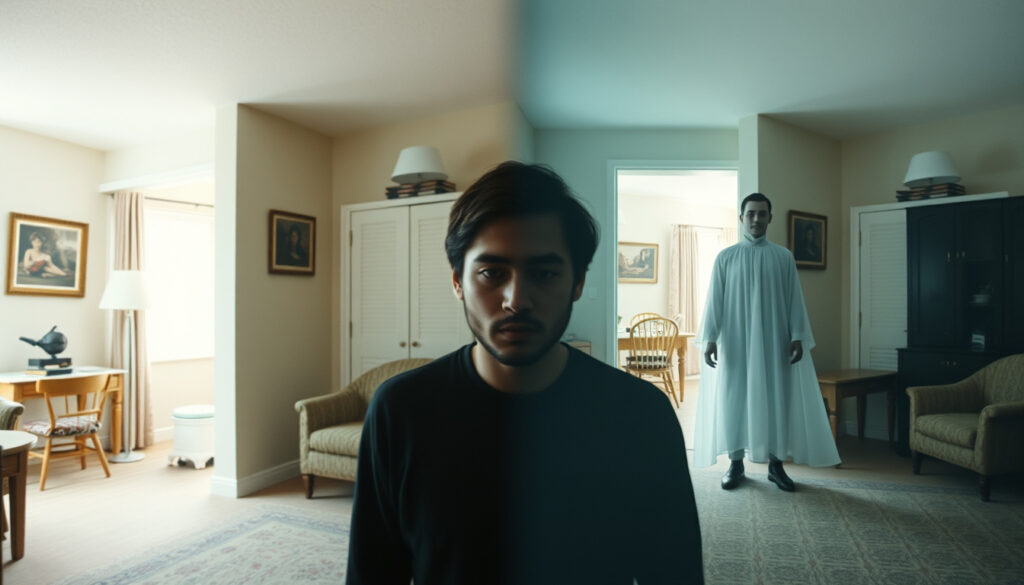
There’s a moment when the room feels like a replay of a dream you can’t remember. That flash of false familiarity—déjà vu—is one of the most common yet least understood experiences in psychology.
Prevalence: 60-70% of the population ·
Peak age range: 15-25 years old ·
Frequency decline: Declines after age 25 ·
Medical association: Common in temporal lobe epilepsy
Quick snapshot
- Illusion of familiarity
- French for ‘already seen’
- Common experience
- Medial temporal lobe involvement
- Dual processing hypothesis
- Memory retrieval errors
- Christian and Islamic perspectives
- Past life theories
- Psychic interpretations
- Peaks in teens/20s
- Declines with age
- Not a sign of dementia
Six key figures capture the déjà vu phenomenon at a glance, from its first naming to its typical duration.
| Label | Value |
|---|---|
| First described by | Émile Boirac (1876) |
| French term meaning | Already seen |
| Lifetime prevalence | 60–70% |
| Typical duration | 10–30 seconds |
| Common age range | 15–25 years |
| Associated with | Memory, temporal lobe epilepsy |
What is déjà vu and why does it happen?
What is déjà vu?
- Déjà vu, a French term coined by psychic researcher Émile Boirac, means ‘already seen’ (Got Questions (Christian Q&A site)).
- It is also called paramnesia, a feeling that a new situation has occurred before (Got Questions).
- The experience is an illusion of memory—despite strong familiarity, the time, place, and context of the ‘previous’ experience remain uncertain or impossible (Wikipedia (user-contributed encyclopedia)).
Why does déjà vu feel so familiar?
- Neurobiologists suggest déjà vu could be explained by parts of the brain being out of sync (MindBodyGreen (wellness media site)).
- A 2010 study in Psychology of Motivation and Learning identified split perception as a potential mechanism: a brief glance at a scene before a fully aware look makes the second conscious view feel eerily duplicated (MindBodyGreen).
- Implicit memory—a previous setting stored in an indistinct manner—may also trigger the sensation (MindBodyGreen).
The leading scientific theories
- Dual processing theory: a delay between two neural pathways creates the feeling that one event has happened twice (BBC Bitesize (UK educational service)).
- Medial temporal lobe errors: the region responsible for memory retrieval misfires, producing a sense of familiarity without actual recall (BBC Bitesize).
- Scientific consensus holds that déjà vu is a real, widely reported experience, but no single theory has been proven (Wikipedia).
The dual-processing explanation means your brain may be running two parallel operations—one fast, one slow—and when they collide, you get a ghost of a memory that never existed. For the average reader, it’s a reminder that perception is not a live feed but a construction.
What happens in déjà vu?
The subjective experience
- The experience typically lasts a few seconds, rarely more than 30 seconds (MindBodyGreen).
- It involves a strong sense of familiarity without specific recollection—you know you’ve been here before, but you can’t place when, where, or how (Verywell Mind (licensed mental health resource)).
- Some people describe a mild dizziness or a feeling of unreality during the episode (BBC Bitesize).
Brain activity during a déjà vu episode
- Functional MRI studies show activity in the frontal and temporal lobes during déjà vu (MindBodyGreen).
- Neuroscientists have identified the temporal region as the brain location responsible for the experience (MindBodyGreen).
- Déjà vu has been induced in the laboratory by electrically stimulating certain cortical structures (MindBodyGreen).
How it differs from actual memory recall
- True memory recall brings specific context—time, place, people. Déjà vu offers only the feeling of memory without context (Verywell Mind).
- It is not a memory, but a sensation of memory—a glitch in the brain’s familiarity-detection system (Wikipedia).
Because déjà vu feels so convincingly like a real memory, people often try to ‘prove’ it by searching for a previous visit to the same place. But that search is exactly the error: the brain has given you a feeling with no attached data. The more you trust it, the more real it seems.
The implication: déjà vu is a window into how the brain builds a sense of reality—if a few milliseconds of mismatched signals can create a whole false memory, your everyday sense of ‘now’ may be more fragile than you think.
Can déjà vu be a warning?
Déjà vu and epilepsy
- Temporal lobe epilepsy can cause frequent, intense déjà vu that lasts longer than normal episodes (MindBodyGreen).
- Seizure-related déjà vu often occurs with other symptoms like confusion, automatisms, or a rising sensation in the stomach (BBC Bitesize).
- About 60% of people with temporal lobe epilepsy report déjà vu as part of their aura (Wikipedia).
When déjà vu might indicate a medical condition
- Healthy individuals experience déjà vu only occasionally—a few times per year at most (Verywell Mind).
- Migraines, anxiety, and dissociation are also associated with more frequent and extended déjà vu experiences (MindBodyGreen).
- Recurrent, bizarre déjà vu that disrupts daily life warrants a medical evaluation, especially if accompanied by loss of awareness (BBC Bitesize).
Distinguishing normal from seizure-related déjà vu
- Normal déjà vu: less than 30 seconds, no motor signs, full awareness, rare (a few times a year) (Verywell Mind).
- Seizure-related déjà vu: can last minutes, may include lip smacking, staring, or automatisms, often feels more ‘physical’ than ‘mental’ (Wikipedia).
- A neurologist can use EEG to differentiate epileptic from non-epileptic déjà vu (Frontiers for Kids (academic outreach journal)).
The trade-off: déjà vu is usually harmless, but when it becomes frequent or intense, it flips from a curious brain glitch to a potential medical signal. For the roughly 1 in 1,000 people with untreated temporal lobe epilepsy, that fleeting false memory may be the first clue.
What does God say about déjà vu?
Christian interpretations
- Some Christians link déjà vu to God’s omniscience—a divine reminder that God already knows all moments (Got Questions).
- Others see it as a glimpse of a predetermined plan or a memory from a previous life, though this is not mainstream Christian doctrine (Got Questions).
- The Bible does not explicitly mention déjà vu, leaving room for personal interpretation (Got Questions).
Islamic view of déjà vu
- In Islam, déjà vu may be interpreted as a glimpse of previous knowledge or a sign from Allah, reflecting the concept that all events are recorded in the Preserved Tablet (Got Questions).
- Some Islamic scholars suggest it could be a reminder of a past life experience, though this is speculative and not based on definitive texts (Got Questions).
Spiritual and metaphysical meanings
- Spiritual traditions often view déjà vu as a connection to past lives, precognitive dreams, or a sixth sense awakening (MindBodyGreen).
- New Age interpretations: déjà vu may indicate alignment with one’s life path or a message from higher consciousness (BBC Bitesize).
- No single religious or spiritual doctrine universally explains déjà vu—it remains a phenomenon that science and faith each approach from different angles (Verywell Mind).
For believers, déjà vu can be a comforting sign that life is meaningful and watched over. For skeptics, it’s a reminder that the brain’s predictive machinery can produce profound emotional experiences out of a timing error. Neither view invalidates the other—they simply operate in different domains.
What this means: spiritual interpretations of déjà vu fill the gap that science leaves open—why a purely physical event feels so richly significant. For many, the meaning is not in the mechanism but in the moment.
At what age does déjà vu stop?
Age-related frequency of déjà vu
- Déjà vu peaks in adolescence and young adulthood, with the highest frequency between ages 15 and 25 (Verywell Mind).
- Frequency decreases markedly after age 25, and continued decline throughout life (BBC Bitesize).
- Older adults still report déjà vu but much less frequently—perhaps a few times per decade (Wikipedia).
Why younger people experience it more often
- The decline may be due to changes in memory systems and neural plasticity; younger brains are more active in forming and retrieving memories, which increases the chance of misfires (MindBodyGreen).
- Some researchers suggest that déjà vu is linked to dopamine activity, which peaks in adolescence (Frontiers for Kids).
- Frequent déjà vu in young adults is considered normal and not a sign of cognitive decline (Verywell Mind).
Does déjà vu completely disappear?
- No, déjà vu does not disappear entirely—it merely becomes rarer. Most older adults can recall at least one experience (Wikipedia).
- Completely eliminating déjà vu would require a disruption of the memory system that most people would prefer to keep intact (BBC Biteside).
Why this matters: the age pattern confirms déjà vu is tied to brain maturation. It’s not a sign of dementia or mental illness—it’s actually a sign of a young, active memory system. As that system slows with age, the glitches also slow down.
What’s clear and what’s not
Confirmed facts
- Déjà vu is a real, widely reported experience (Wikipedia).
- It is linked to temporal lobe function and memory processing (MindBodyGreen).
- Frequency peaks in young adulthood and declines with age (Verywell Mind).
- It can be a symptom of temporal lobe epilepsy (BBC Bitesize).
What’s unclear
- The exact neural mechanism is not fully understood (Wikipedia).
- Why it feels so convincingly like a real memory (Verywell Mind).
- Whether it has any adaptive function (Frontiers for Kids).
- Spiritual explanations remain unverifiable by science (Got Questions).
It is an illusion of memory whereby—despite a strong sense of recollection—the time, place, and context of the “previous” experience are uncertain or impossible.
Wikipedia
Déjà vu may occur when, for some reason or another, something goes wrong in the medial temporal lobe that triggers a memory sensation known as familiarity.
BBC Bitesize
Deja vu is a sense of having already seen something—even though you know you haven’t.
Verywell Mind
For anyone who has ever been stopped in their tracks by a feeling of false familiarity, the takeaway is that déjà vu is not a psychic warning or a memory error—it’s a glimpse into how the brain builds reality from timing and expectation. The next time it happens, you’ll know: your brain’s prediction engine just tripped over itself. For the curious reader, the choice is clear: either accept the neural glitch and move on, or use it as a prompt to explore the deeper puzzles of consciousness that déjà vu reveals.
The article What Is Déjà Vu? offers a comprehensive overview for those curious about the science behind it.
Frequently asked questions
How long does déjà vu usually last?
Typical déjà vu episodes last between 10 and 30 seconds. Very rarely do they extend beyond a minute (Verywell Mind).
Can stress trigger déjà vu?
Yes. Anxiety and stress are associated with more frequent déjà vu experiences, likely because they affect brain rhythms and memory retrieval (MindBodyGreen).
Is déjà vu a sign of a brain problem?
Occasional déjà vu (a few times per year) is normal. However, frequent, intense, or prolonged déjà vu—especially with confusion or automatisms—can indicate temporal lobe epilepsy and warrants a medical check (BBC Bitesize).
Does everyone experience déjà vu at some point?
No. About 60-70% of people report at least one déjà vu experience. The remaining 30-40% either don’t experience it or don’t recognize the sensation (Got Questions).
What is the difference between déjà vu and déjà vécu?
Déjà vu is the feeling of having ‘already seen’ something. Déjà vécu (‘already lived’) is a more intense sensation where the entire event feels like a reenactment of a previous experience, with specific details lining up (Wikipedia).
Can déjà vu be induced intentionally?
Yes, in controlled settings. Scientists have induced déjà vu by electrically stimulating parts of the medial temporal lobe or by using virtual reality scenarios that create conflicting familiarity signals (MindBodyGreen).
More related posts
 What Is the Weather Tomorrow? Dublin & Ireland Forecast
 SCDCA Warns of Data Breach: What SC Residents Need to Know
 Ryan Gosling Plastic Surgery: Did He Go Under the Knife?
 Is Jenna Ortega Gay – Facts, Rumors & Relationship Status
 Women’s Cricket World Cup: India’s Record, 2026 Host, Explained
 When Is Father’s Day 2026? Exact Date for Ireland & US
 How to Take a Screenshot on Mac – All Shortcuts Explained
 United States at the Winter Olympics – Medals, History, Records