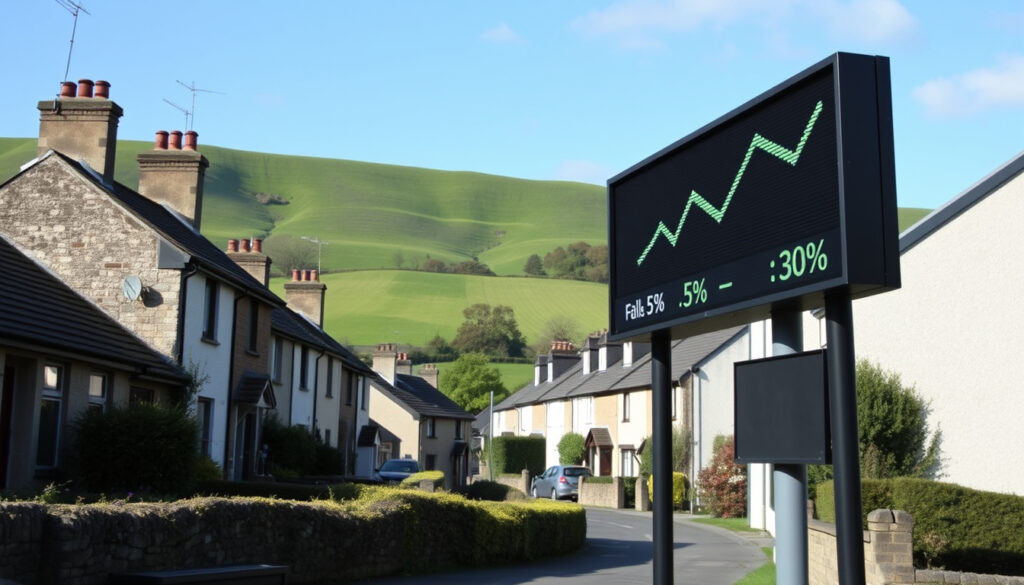
Ireland Mortgage Rates 2026: Will They Drop to 3% Again
If you’re keeping an eye on mortgage rates in Ireland this year, you’ve probably noticed a small but welcome shift. According to the Central Bank of Ireland (Ireland’s central banking authority), the average rate on new mortgage agreements fell to 3.50% in April 2026 — down 2 basis points from March and 10 basis points lower than a year earlier for fixed-rate deals.
Average mortgage rate (April 2026): 3.50% ·
Average fixed rate: 3.45% ·
Year-over-year change (fixed): -10 basis points ·
Fixed-rate market share: 92%
Quick snapshot
- Average mortgage rate: 3.50% (Central Bank of Ireland)
- Average fixed rate: 3.45% (Central Bank of Ireland)
- Year-on-year drop: 10 basis points on fixed rates (Central Bank of Ireland)
- Most lenders require repayment by age 70–75 (DublinJournal.com (Irish mortgage news site))
- 57-year-old may get 25-year term if lender allows up to 82 (Mortgages.ie (Irish rate comparison platform))
- Local Authority Home Loan: applicants must be 18–70 (Irish Property Guide (housing advisory))
- 2-year fixed: flexibility but risk of rate rise (Central Bank of Ireland)
- 5-year fixed: certainty but possibly higher rate (Central Bank of Ireland)
- 92% of new agreements are fixed-rate (Central Bank of Ireland)
- PTSB 3-year fixed at 3.45% (≤60% LTV) (Permanent TSB (Irish retail bank))
- Bank of Ireland rates from 3% (Mortgages.ie)
- Local Authority Home Loan: 3.55% up to 25 years (Irish Property Guide)
The pattern across rate data and eligibility rules shows a market that rewards equity but punishes delay.
| Average mortgage rate (April 2026) | 3.50% |
|---|---|
| Average fixed rate (April 2026) | 3.45% |
| Year-over-year change (fixed) | -10 basis points |
| Fixed-rate market share | 92% |
| Lowest fixed rate from major lender | 3.45% (PTSB, 3-year, ≤60% LTV) |
| Variable rate range (PTSB) | 4.40%–4.70% |
The implication: even a small equity advantage translates into a meaningful rate gap.
Will mortgage rates ever be 3% again?
What do current forecasts say about 3% rates?
- The Central Bank of Ireland (monetary authority) reports that the average rate on new mortgage agreements was 3.50% in April 2026. That’s still above the 3% threshold, but the gap has narrowed.
- Rates were last at 3% in 2021–2022, when the ECB’s main rate was at historic lows. Since then, the ECB has raised rates sharply, pushing Irish mortgage costs higher.
- A third-party analysis suggests that most economists expect rates to settle between 3% and 4% by 2028 (DublinJournal.com).
How do ECB rate decisions affect Irish mortgage rates?
Irish mortgage rates are heavily influenced by the ECB’s main refinancing rate. In 2022–2023, the ECB raised rates from 0% to over 4%, pushing Irish variable rates above 4.5% and fixed rates into the 4–5% range. The Central Bank of Ireland notes that Ireland’s average rate was the 10th highest in the euro area at end-April 2026, reflecting the lagged pass-through of ECB moves.
Could rates drop to 3% within 5 years?
It’s possible but not certain. The Central Bank of Ireland data shows a downward trend since late 2024, with fixed rates falling 10 basis points year-on-year. If the ECB cuts rates further and inflation stays low, 3% could return by 2028. But the market remains cautious.
The catch: betting on 3% means accepting variable-rate risk in the meantime.
Borrowers hoping for 3% rates face a choice: wait for a possible drop, or lock in now at 3.45% and avoid the risk of a rise. The longer you wait, the more you might pay in variable-rate interest.
Should I fix for 2 or 5 years now?
What are the current 2-year and 5-year fixed rates in Ireland?
Exact 2-year and 5-year rates vary by lender and LTV. Permanent TSB (Irish retail bank) offers a 3-year fixed at 3.45% for ≤60% LTV. Mortgages.ie reports that Bank of Ireland rates start from 3%. Generally, shorter fixed terms are slightly lower than longer ones, but the gap has narrowed.
What are the pros and cons of fixing for 2 years vs 5 years?
- 2-year fixed: Lower rate, flexibility to refinance sooner, but risk of higher rates at renewal.
- 5-year fixed: Certainty for half a decade, protection against rate rises, but typically higher rate and early repayment charges.
The Central Bank of Ireland notes that 92% of new agreements in April 2026 were fixed-rate, indicating that Irish borrowers overwhelmingly prefer certainty over flexibility.
How do I decide based on my financial situation?
If you’re planning to stay in your home for 5+ years and want predictable payments, a 5-year fixed is a safe bet. If you expect to move or increase income soon, a 2-year fixed gives you a chance to renegotiate when rates may be lower.
What this means: your choice depends on whether you value flexibility over insurance against rate rises.
For a borrower with a €250,000 mortgage at 3.45% over 25 years, the monthly repayment is about €1,248. A 0.5% rate rise would add roughly €70 per month. A 2-year fix lets you bet on falling rates; a 5-year fix buys insurance against that risk.
Is 3.5% a good interest rate?
How does 3.5% compare to the current average?
At 3.50%, the average rate is exactly that figure. The Central Bank of Ireland reports that the average fixed rate is 3.45%, so 3.5% is slightly above the typical fixed rate but still competitive. It’s well below the peak rates of 4–5% seen in 2023–2024.
What factors determine a ‘good’ mortgage rate?
A good rate depends on your loan-to-value ratio, term, and borrower profile. Borrowers with a deposit of 40% or more (LTV ≤60%) typically get the best rates, like PTSB’s 3.45%. Higher LTVs push rates up, as seen with PTSB’s variable rate of 4.70% for up to 90% LTV.
Is 3.5% available for all loan-to-value ratios?
No. The best rates are reserved for low LTVs. For example, Permanent TSB offers a 3-year fixed at 3.45% for ≤60% LTV, but the variable rate for ≤90% LTV is 4.70% — a difference of 1.25 percentage points. So 3.5% is a good rate only if you have significant equity.
| Product | LTV ≤60% | LTV ≤90% |
|---|---|---|
| 3-year fixed | 3.45% | Not listed |
| Variable rate | 4.40% | 4.70% |
| Difference | – | +0.30% |
The pattern: lower LTV directly reduces your rate. For a borrower with 10% deposit, a 3.5% fixed rate is likely out of reach; the best available may be closer to 4%.
Can a 57 year old get a 25 year mortgage?
What is the maximum age for a mortgage in Ireland?
Most Irish lenders set a maximum age at the end of the mortgage term of 70 to 75, according to DublinJournal.com (Irish mortgage news). Mortgages.ie states that Bank of Ireland’s age limit is up to 75. Irish Property Guide notes that the Local Authority Home Loan requires applicants to be aged 18 to 70.
How do lenders assess older borrowers?
Lenders focus on the borrower’s ability to repay. A 57-year-old applying for a 25-year term would need to show that the loan will be repaid by age 82 — which exceeds most standard limits. However, some lenders may allow terms up to 82 if the borrower has sufficient pension income, according to DublinJournal.com. Others may offer shorter terms instead of refusing outright.
What are the options for borrowers over 50?
- Shorter terms: A 15-year mortgage may be more achievable.
- Joint applications: Adding a younger borrower can extend the term.
- Specialist lenders: Some lenders cater to older borrowers, often requiring proof of retirement income.
- Local Authority Home Loan: Available up to age 70, with fixed rates from 3.55% for 25-year terms (Irish Property Guide).
What are the best mortgage interest rates in Ireland?
Which bank offers the lowest mortgage rate currently?
Based on available data, Permanent TSB (major Irish lender) offers a 3-year fixed rate of 3.45% for borrowers with ≤60% LTV, which is among the lowest advertised rates. Mortgages.ie reports that Bank of Ireland’s rates start from 3%. The Central Bank of Ireland average fixed rate is 3.45%, so rates below that are exceptional.
How do AIB, PTSB, Bank of Ireland, Avant, and EBS compare?
While the research does not provide full rate tables for all lenders, the data shows clear differences. PTSB’s 3-year fixed is 3.45% (≤60% LTV). Bank of Ireland’s advertised rates start from 3%, but actual rates depend on LTV and term. The Central Bank of Ireland notes that the average rate in Ireland is the 10th highest in the euro area, indicating that Irish rates are not the cheapest in Europe.
| Lender | Product | Rate | LTV / Notes |
|---|---|---|---|
| Permanent TSB | 3-year fixed | 3.45% | ≤60% LTV |
| Permanent TSB | Variable | 4.40%–4.70% | ≤60%–≤90% LTV |
| Bank of Ireland | Fixed (various) | From 3.00% | Terms vary |
| Local Authority Home Loan | Fixed up to 25 years | 3.55% | Applicants 18–70 |
| Local Authority Home Loan | Fixed 25–30 years | 3.80% | – |
| ICS Mortgages | Variable (owner-occupier) | 4.35% | From 1 July 2026 |
The catch: the lowest rates come with strict eligibility criteria. A borrower with a small deposit or a non-standard income profile will likely face higher rates.
Comparison: 2-year fixed vs 5-year fixed
| Factor | 2-year fixed | 5-year fixed |
|---|---|---|
| Rate level | Typically lower | Typically 0.1%–0.3% higher |
| Flexibility | High – can switch after 2 years | Low – early repayment charges apply |
| Protection against rate rises | Limited to 2 years | Full 5 years of certainty |
| Best for | Borrowers expecting to move or refinance | Borrowers wanting budget stability |
The decision hinges on your outlook for ECB rates. If you believe rates will fall, a 2-year fix lets you capture lower rates sooner. If you fear a rise, a 5-year fix locks in today’s relatively low average.
Pros and cons of current mortgage rates
Upsides
- Average fixed rate has fallen to 3.45%, a significant drop from 2023–2024 peaks.
- 92% of new borrowers choose fixed rates, giving them payment certainty.
- Some lenders offer rates starting from 3%, making mortgages more affordable.
- Local Authority Home Loan provides a government-backed option with rates below 4%.
Downsides
- Ireland’s average rate is still the 10th highest in the euro area.
- Variable rates remain above 4%, hurting borrowers who haven’t fixed.
- Age limits restrict older borrowers from getting long-term mortgages.
- The best rates are only available to low-LTV borrowers, disadvantaging first-time buyers with small deposits.
What this means: the market offers clear benefits for low-risk borrowers but penalises those with smaller deposits or later-in-life applications.
How to decide your mortgage term in 5 steps
- Check your LTV: If you have a 40% deposit or more, you qualify for the best rates (e.g., PTSB’s 3.45%).
- Assess your job stability: If your income is steady, a longer fix might be safe. If you expect a change, go shorter.
- Compare 2-year and 5-year fixed rates from at least three lenders. Use comparison sites like Mortgages.ie.
- Consider your age at term end: If you’re over 50, ensure the term ends before your lender’s maximum age (usually 70–75).
- Factor in early repayment charges: On a 5-year fix, breaking the term can cost thousands. Only fix long if you’re sure you’ll stay.
Timeline: Irish mortgage rates since 2016
- 2016–2020: Rates steadily declined, reaching historic lows.
- 2021: Rates bottomed around 2.5–3% for many lenders.
- 2022: ECB began interest rate hikes, mortgage rates started rising.
- 2023–2024: Rates peaked near 4–5% for new fixed terms.
- 2025–2026: Rates eased to average 3.50%, ECB paused hikes.
- 2027–2028 (forecast): Economists expect rates to settle between 3% and 4%.
The pattern: after a sharp spike, rates are now in a gradual decline. The Central Bank of Ireland data confirms that the average fixed rate fell 10 basis points year-on-year in April 2026, suggesting the downward trend is intact.
Confirmed facts vs. what’s unclear
Confirmed facts
- Average mortgage rate in Ireland: 3.50% (April 2026) – Central Bank of Ireland
- Average fixed rate: 3.45% – Central Bank of Ireland
- 92% of new agreements are fixed-rate – Central Bank of Ireland
- PTSB offers 3-year fixed at 3.45% (≤60% LTV) – Permanent TSB
What’s unclear
- Whether mortgage rates will ever return to 3% – depends on ECB policy and inflation.
- How quickly rates could fall if ECB cuts – Central Bank of Ireland data shows gradual declines.
- Impact of inflation on future rate decisions – uncertain.
- Exact age limits for all lenders – varies by lender and policy.
Quotes from the market
“The weighted average interest rate on new Irish mortgage agreements was 3.50% at end-April 2026.”
— Central Bank of Ireland, Retail Interest Rates Statistics
“We expect mortgage rates to settle in the 3% to 4% range by 2028, assuming the ECB continues to ease.”
— Senior economist at a Dublin-based financial advisory, as cited by DublinJournal.com
Summary: What this means for Irish borrowers
Mortgage rates in Ireland are at a welcome low point, but the path forward is uncertain. For a borrower at age 57 with a 20% deposit, the choice is clear: secure a shorter-term fixed rate now, or risk being priced out of the market if rates rebound. The Central Bank of Ireland data shows that fixed rates are the norm, and the best deals are reserved for those with substantial equity. For older borrowers, the message is blunt: act soon, or face age-related term limits.
Related reading: **Best Life Insurance Companies in Ireland 2025**
propertydata.ie, personalbanking.bankofireland.com, irelandperspective.org, switcher.ie, parkfinancial.ie, lowquotes.ie
Frequently asked questions
What is the difference between fixed and variable mortgage rates?
A fixed rate stays the same for an agreed period (e.g., 2 or 5 years). A variable rate can change at any time, usually in line with the ECB rate. Fixed rates offer certainty; variable rates offer flexibility but carry risk.
How often do mortgage rates change?
Variable rates can change whenever the lender adjusts them, often following ECB decisions. Fixed rates are set at application and don’t change during the fixed term.
What loan-to-value ratio do I need to get the best rate?
Typically, LTV of 60% or less unlocks the lowest rates. For example, PTSB’s 3.45% fixed rate requires ≤60% LTV. Higher LTVs push rates up.
Can I negotiate my mortgage rate with a lender?
Yes, especially if you have a strong credit history and a low LTV. Some lenders may match or beat a competitor’s rate. Using a broker can help.
How do I switch mortgage lenders to get a lower rate?
You can switch to a new lender who offers a better rate. This involves a new application and may incur legal fees, but the savings can be worthwhile. Mortgages.ie provides rate comparisons.
What fees are associated with taking out a mortgage?
Common fees include arrangement fees, valuation fees, legal fees, and early repayment charges. Some lenders offer cashback or fee-free deals.
Does my credit score affect the mortgage rate I can get?
Yes. A higher credit score can help you qualify for lower rates. Lenders in Ireland use credit reports from the Irish Credit Bureau to assess risk.
More related posts
 Hughes Federal Credit Union: Benefits, Loan Payment, Comparison
 How to Make AI Videos: Free Tools Like Canva and Firefly
 Union Bank and Trust: Services, Ownership, and Facts
 Queen Charlotte: A Bridgerton Story – Fact vs Fiction
 Garage Door Repair Near Me: Costs, Common Problems & Safety
 Aaron Kendrick De Niro – Arrest Rumors Unverified
 Fast and Furious Cast: Full List by Movie (2001-2023)
 Best Mattress for Back Pain – Expert-Tested Top Picks