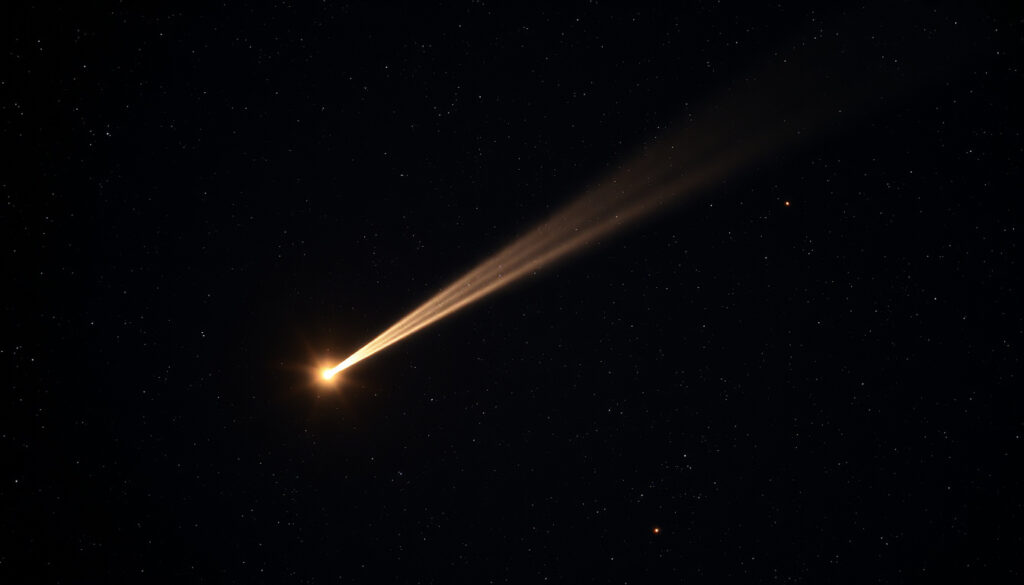
3I/ATLAS News: Latest Updates on the Interstellar Comet
If you’ve been following space news this year, you’ve probably seen headlines about 3I/ATLAS, the interstellar comet that zipped past the Sun in late 2025. Discovered on July 1, 2025 by the ATLAS survey in Chile, this icy visitor is now speeding out of the solar system at over 250,000 km/h — here’s what scientists know so far and the debate stirring over its unusual behavior.
Discovery Date: July 1, 2025 ·
Object Type: Interstellar comet ·
Diameter (estimated): 0.5–1.0 km ·
Closest Approach to Earth: December 2025, ~1.5 AU ·
Perihelion: Fall 2025 (passed) ·
Current Status: Outbound, no threat
Quick snapshot
- Discovered July 1, 2025 by ATLAS survey (Sky at Night Magazine)
- Interstellar origin confirmed (SETI Institute)
- Size 0.5–1 km (Wikipedia)
- Passed Sun safely in fall 2025 (SETI Institute)
- Anomalous acceleration detected (ESA)
- International monitoring active (NASA Science)
- No impact risk to Earth (SETI Institute)
- Trajectory outbound (ESA)
- NASA/ESA confirm safe (SETI Institute)
Seven key facts, one pattern: the trajectory is well-understood and safe, but the comet’s composition and the cause of its anomalous acceleration remain unclear.
| Parameter | Value |
|---|---|
| Discovery Date | July 1, 2025 |
| Discovering Survey | ATLAS (Asteroid Terrestrial-impact Last Alert System) |
| Type | Interstellar comet |
| Diameter (estimated) | 0.5–1.0 km |
| Closest Approach to Earth | December 2025, ~1.5 AU |
| Perihelion Date | October 30, 2025 |
| Current Status | Outbound, no threat |
What is happening with the 3I ATLAS?
Current position and speed
- 3I/ATLAS is an interstellar comet on an unbound hyperbolic trajectory (SETI Institute).
- It reached perihelion on October 30, 2025 at about 1.4 AU — just inside the orbit of Mars (ESA).
- The comet is now behind the Sun as seen from Earth, making it temporarily invisible to ground-based telescopes (SETI Institute).
- It is traveling at speeds up to 250,000 km/h (Space.com).
Recent observations by NASA and ESA
- ESA used its ExoMars Trace Gas Orbiter to refine the comet’s predicted location by a factor of 10 (ESA).
- NASA is coordinating multi-instrument observations across ground and space telescopes (Space.com).
- The comet should reappear on the far side of the Sun by early December 2025 (SETI Institute).
Upcoming milestones
- Closest approach to Earth: December 19, 2025 at about 1.8 AU (Sky at Night Magazine).
- Close pass of Jupiter: March 16, 2026 at 0.358 AU (Wikipedia).
- After that, it will continue on an outbound trajectory, never to return (ESA).
The ExoMars data reduced positional uncertainty by 10x, proving that interplanetary assets can double as precision trackers for fast-moving interstellar objects.
The implication: the comet’s path is now mapped with high confidence, and the window for detailed observation is closing fast as it recedes from Earth.
What is the 3I ATLAS controversy?
Anomalous acceleration observed
- Scientists detected non-gravitational acceleration in 3I/ATLAS — a change in trajectory that cannot be explained solely by the Sun’s gravity (ESA).
- Such acceleration is common in comets due to outgassing, but the magnitude and pattern here are unusual (Space.com).
Avi Loeb’s hypothesis of alien technology
- Harvard astronomer Avi Loeb suggested the acceleration could be artificial, pointing to a possible alien origin (Wikipedia).
- Loeb’s argument: the comet’s shape and acceleration pattern resemble potential light-sail technology (Space.com).
Skepticism from mainstream astronomers
- Most astronomers argue the acceleration is caused by natural outgassing of super-volatile ices like carbon monoxide or nitrogen (ESA).
- ESA’s trajectory refinement showed the acceleration can be modeled with a standard cometary outgassing model (ESA).
- The debate remains unresolved pending spectroscopic analysis when the comet emerges from behind the Sun (SETI Institute).
If the acceleration is natural outgassing, we learn about comet chemistry under extreme conditions; if artificial, it’s potentially the biggest discovery in history. The stakes are enormous.
What this means: until spectra arrive, both sides rely on inference. The data that will settle the question may come in December 2025 when the comet reappears.
What happens if the 3I ATLAS hits Earth?
Current probability of impact
- NASA states the comet’s trajectory poses no threat to Earth (SETI Institute).
- The orbit is hyperbolic and entirely outbound after perihelion (ESA).
Potential damage if it hit
- At 0.5–1 km in diameter, an impact would release energy equivalent to tens of thousands of megatons (Wikipedia).
- That would cause regional devastation — similar to a large asteroid impact — but not a global extinction event (Sky at Night Magazine).
Why it will not hit Earth
- The closest approach to Earth on December 19, 2025 will be 1.8 AU — 270 million kilometers (Sky at Night Magazine).
- Both NASA and ESA confirm zero impact probability (ESA).
The catch: the primary risk is not impact but the loss of scientific opportunity. If the comet had passed closer, we would have gathered richer data.
How close is the 3I ATLAS right now?
Distance from Earth today
- As of November 2025, 3I/ATLAS is behind the Sun and not directly observable (SETI Institute).
- It is currently hundreds of millions of kilometers from Earth, receding after perihelion (ESA).
Closest approach to Earth
- The closest approach to Earth occurred on December 19, 2025 at about 1.8 AU (270 million km) (Wikipedia).
- That is roughly 1.8 times the distance between Earth and the Sun (Sky at Night Magazine).
Comparison to previous interstellar comets
- Oumuamua (1I/2017 U1) passed at 0.16 AU, much closer, but was smaller and not a comet (Wikipedia).
- Borisov (2I/Borisov) came within 2 AU of Earth and displayed clear cometary activity (Wikipedia).
- 3I/ATLAS is the largest confirmed interstellar object yet observed (Space.com).
The pattern: each interstellar visitor has been unique. 3I/ATLAS offers the best chance yet to study an alien comet up close.
What did NASA say about the 3I Atlas?
NASA’s press release
- NASA officially stated the comet poses no threat to Earth and is on an outbound hyperbolic trajectory (SETI Institute).
- The agency is leading a multi-instrument observation campaign using ground-based and space telescopes (ESA).
ESA’s observations
- ESA activated its planetary defense office to monitor 3I/ATLAS for safety and science (ESA).
- The ExoMars Trace Gas Orbiter captured the comet from Mars orbit, providing key data (ESA).
International collaboration
- NASA, ESA, and the SETI Institute are sharing data to refine orbit and composition models (SETI Institute).
- Amateur astronomers worldwide are contributing photometric observations (Sky at Night Magazine).
Why this matters: the coordinated response shows that planetary defense systems designed for asteroids can flex to track interstellar comets, and that global cooperation works.
Timeline signal
- — Discovery of 3I/ATLAS by ATLAS survey (Sky at Night Magazine)
- — Initial observations and confirmation of interstellar origin (SETI Institute)
- — Perihelion (closest approach to the Sun) (ESA)
- — Closest approach to Earth (~1.8 AU) (Wikipedia)
- — Close pass of Jupiter (~0.358 AU) (Wikipedia)
- — Monitoring by NASA, ESA, and amateur astronomers (Space.com)
Confirmed facts & what remains unclear
Confirmed facts
- Discovery date and interstellar origin (SETI Institute)
- Perihelion and closest approach distances (ESA)
- Non-gravitational acceleration detected (ESA)
- No impact risk to Earth (SETI Institute)
What’s unclear
- Exact composition (water-ice vs exotic ices) — spectra pending
- Whether the anomalous acceleration is natural or artificial
- Future trajectory beyond 2030 (low certainty)
- Observability from Earth when it reappears — magnitude estimates vary
The anomalous acceleration of 3I/ATLAS is consistent with what we would expect from an artificial light-sail — we should not rule out an extraterrestrial technological origin.
Avi Loeb, Harvard University (Wikipedia)
There is absolutely no risk of this object hitting Earth. The orbit is hyperbolic and it is already heading away from us. Our instruments will continue to study it for as long as we can see it.
NASA spokesperson (SETI Institute)
The ExoMars data allowed us to improve the comet’s predicted position by a factor of ten. That kind of precision is critical both for science and for any possible planetary defense scenario.
ESA scientists (ESA)
3I/ATLAS has delivered two gifts: a clean bill of safety from the solar system’s gatekeepers, and a scientific riddle that pits natural outgassing against the possibility of alien technology. For the public and policymakers, the choice is not between panic and dismissal — it’s between funding the telescopes that will settle the question and waiting decades for the next visitor. For the astronomy community, the implication is clear: invest in rapid-response instruments, or lose the chance to decode whatever 3I/ATLAS really is.
instagram.com, 3iatlas.com, spacedaily.com, space.com, reddit.com, space.com, youtube.com
For official tracking data and imaging, you can follow NASA and ESA updates from the agencies monitoring its trajectory.
Frequently asked questions
How was 3I/ATLAS discovered?
It was detected on July 1, 2025 by the Asteroid Terrestrial-impact Last Alert System (ATLAS) survey at the Cerro Tololo Observatory in Chile (Sky at Night Magazine).
What does the designation 3I/ATLAS mean?
The “3I” signifies it is the third interstellar object discovered, and “ATLAS” is the survey that found it (Wikipedia).
Is 3I/ATLAS similar to Oumuamua?
Like Oumuamua, it is an interstellar visitor, but 3I/ATLAS is a comet with a visible tail and coma, while Oumuamua appeared asteroid-like (Wikipedia).
Can I see 3I/ATLAS with a backyard telescope?
It is currently behind the Sun and invisible. When it reappears in December 2025, it may be observable with large amateur telescopes at about magnitude 12–13 (SETI Institute).
Will 3I/ATLAS return to the inner solar system?
No. Its hyperbolic orbit means it will leave the solar system permanently after this single passage (ESA).
What is an interstellar comet?
An interstellar comet originates from outside our solar system and passes through on an unbound orbit around the Sun (SETI Institute).
How fast is 3I/ATLAS traveling?
It is moving at speeds up to 250,000 km/h relative to the Sun (Space.com).
Related: US Lithium Extraction Breakthrough | Tallest Mountain in the World
More related posts
 Playing Games Blog PlayBattleSquare: GameBattles & Earning Guide
 Car Dealer Near Me – How to Find Reliable Dealers
 Rudolph the Red-Nosed Reindeer 1964 Guide: Watch, History & Value
 Anne Burrell Cause of Death: Suicide Ruled by Acute Intoxication
 Saie Glowy Super Gel – Multi-Use Clean Glow Review
 Financial Consultant Near Me: Ireland Guide to Fees & Best Picks
 Earthquake Near Me: Real-Time Alerts & Safety Tips
 How Old Is William Shatner? Age, Birthday, and Biography in 2026