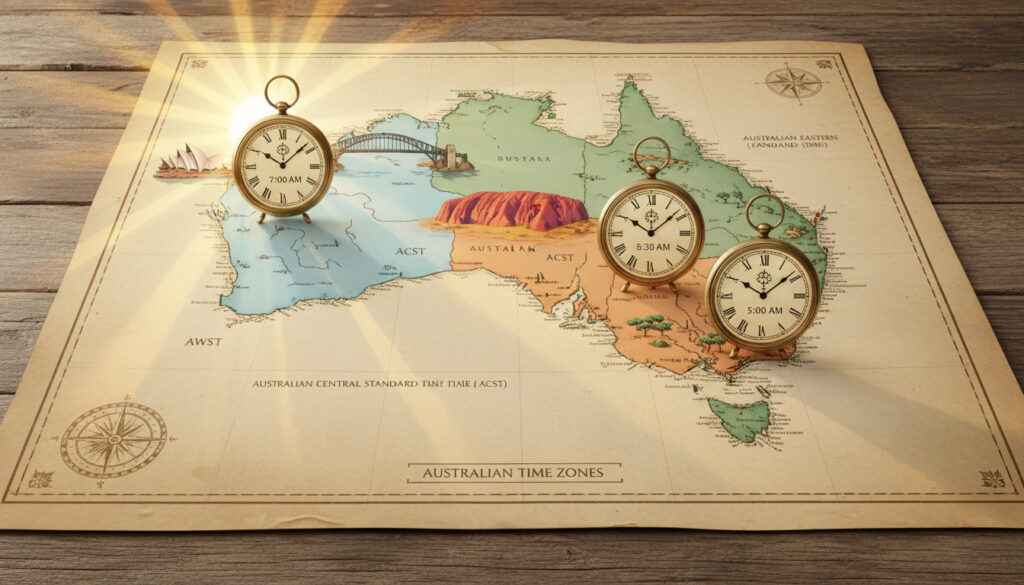
What Time Is It in Australia – Current Times Across Zones
Australia operates across multiple time zones simultaneously, with the current time varying by as much as two and a half hours depending on whether you are in Perth, Sydney, or Darwin. Determining the exact hour requires identifying the specific state or territory, as the continent does not follow a single national clock.
When coordinating across Australian borders, the temporal disparity becomes immediately apparent. While Melbourne may be conducting morning business, Perth remains in the pre-dawn hours. This variation stems from the country’s vast geographic width and distinct state-based legislative approaches to timekeeping.
Understanding these differences demands familiarity with three primary time zone designations, their UTC offsets, and the daylight saving protocols that further alter offsets between October and April.
What Time Is It in Australia Right Now?
No single answer exists for the current time across Australia. The nation functions on a sliding temporal scale ranging from UTC+8 in the west to UTC+10:30 in central regions, with southeastern states shifting to UTC+11 during summer months.
| Sydney | Melbourne | Perth | Darwin |
|---|---|---|---|
| AEST / AEDT* | AEST / AEDT* | AWST | ACST |
| UTC+10 / +11 | UTC+10 / +11 | UTC+8 | UTC+9:30 |
*Daylight saving time applies October through April
Key facts regarding Australian timekeeping include:
- Australia spans three primary standard time zones creating a 2.5-hour differential from east to west
- Australian Eastern Standard Time (AEST, UTC+10) governs Sydney, Melbourne, Brisbane, and Hobart
- Australian Central Standard Time (ACST, UTC+9:30) applies to Adelaide, Darwin, and Alice Springs
- Australian Western Standard Time (AWST, UTC+8) covers Perth and the entirety of Western Australia
- Daylight saving shifts eastern zones to UTC+11 and central zones to UTC+10:30 during designated periods
- Queensland and Western Australia maintain standard time year-round without seasonal adjustment
| City/Region | Standard Time Zone | UTC Offset | Daylight Saving? |
|---|---|---|---|
| Sydney (NSW) | AEST / AEDT | +10 / +11 | Yes |
| Melbourne (VIC) | AEST / AEDT | +10 / +11 | Yes |
| Brisbane (QLD) | AEST | +10 | No |
| Perth (WA) | AWST | +8 | No |
| Adelaide (SA) | ACST / ACDT | +9:30 / +10:30 | Yes |
| Darwin (NT) | ACST | +9:30 | No |
What Are the Time Zones in Australia?
Australia’s temporal architecture divides into three principal standard zones, with a rare exception existing in a remote Western Australian community. Time conversion data confirms these zones remain consistent regardless of international daylight saving changes elsewhere.
Australian Eastern Standard Time (AEST)
AEST operates at UTC+10 and serves as the reference for New South Wales, Victoria, Tasmania, the Australian Capital Territory, and Queensland. Major population centers including Sydney, Melbourne, Canberra, and Brisbane synchronize to this offset during standard time periods.
Australian Central Standard Time (ACST)
ACST maintains a UTC+9:30 offset, positioning it thirty minutes behind eastern counterparts. This zone encompasses South Australia and the Northern Territory, with Adelaide representing the largest city under this designation.
Australian Western Standard Time (AWST)
AWST functions at UTC+8, creating a two-hour lag behind eastern states and a ninety-minute difference from central regions. Perth, with approximately 1.897 million residents, anchors this zone along with other Western Australian centers such as Rockingham and Mandurah.
The town of Eucla in Western Australia observes a unique UTC+8:45 offset, representing a rare 45-minute deviation from standard hourly timekeeping practices found elsewhere on the continent.
Exceptional Geographic Considerations
While the three primary zones cover the majority of the population, geographic time data reveals this unusual 45-minute offset at Eucla, technically placing it between AWST and ACST.
Does All of Australia Use the Same Time?
Australia does not observe uniform national time. The continental breadth of approximately 4,000 kilometers from east to west necessitates multiple zones to maintain alignment with solar noon and practical daily schedules.
Eastern Coordination
The eastern seaboard, containing the population-heavy states of New South Wales and Victoria, coordinates closely despite Queensland’s refusal to adopt daylight saving time. This creates a one-hour divergence between Brisbane and Sydney during summer months even though both share AEST as their standard.
Western and Central Divisions
Western Australia remains temporally isolated, operating two hours behind Sydney when the latter observes standard time. Central Australia splits the difference with its 30-minute offset, creating incremental steps rather than uniform progression across the continent.
Does Australia Have Daylight Saving Time?
Daylight saving time operates in select Australian jurisdictions, creating seasonal shifts that further complicate the temporal landscape. Understanding which states participate proves essential for accurate scheduling.
Daylight saving time concludes on April 5, 2026, when clocks retreat one hour, and resumes on October 4, 2026, when clocks advance. These dates apply specifically to New South Wales, Victoria, South Australia, Tasmania, and the Australian Capital Territory.
Observing States and Territories
During daylight saving periods, affected regions shift to Australian Eastern Daylight Time (AEDT, UTC+11) or Australian Central Daylight Time (ACDT, UTC+10:30). Seasonal time data indicates these transitions occur annually between January and early April, then again from early October through year-end.
Non-Observing Regions
Queensland, the Northern Territory, and Western Australia reject daylight saving time entirely. Brisbane maintains AEST throughout the year, as does the entire state of Queensland despite geographic proximity to daylight-observing New South Wales. For those curious about the actors bringing this story to life, you can explore the Boy Swallows Universe cast. Boy Swallows Universe cast
When Does Daylight Saving Time Start and End?
The Australian daylight saving calendar follows a consistent biannual pattern, though specific dates vary slightly year to year.
- April 5, 2026: Eastern and Central regions revert to standard time (AEST/ACST), clocks move backward one hour at 3:00 AM
- October 4, 2026: Participating states advance to daylight time (AEDT/ACDT), clocks move forward one hour at 2:00 AM
- Year-round consistency: Western Australia maintains AWST without adjustment
- Queensland permanence: Brisbane and Queensland remain on AEST indefinitely
- Northern Territory stability: Darwin observes ACST consistently without seasonal variation
What Facts Are Definitive About Australian Time?
Certain temporal parameters remain fixed while others fluctuate based on seasonal or international factors.
| Established Information | Variable Considerations |
|---|---|
| Three primary zones: AEST (UTC+10), ACST (UTC+9:30), AWST (UTC+8) | Exact current time changes continuously across all zones |
| 2026 DST transitions occur April 5 and October 4 | International time differences vary with foreign DST status |
| Eucla maintains unique UTC+8:45 offset | Future DST legislation remains subject to state parliamentary review |
| Queensland and Western Australia never observe DST | Comparative times with UK and Europe shift seasonally |
Why Does Australia Maintain Multiple Time Zones?
The continental expanse crosses nearly 30 degrees of longitude, making a single time zone impractical for solar alignment. State legislative autonomy allows individual jurisdictions to determine daylight saving participation, resulting in the current patchwork approach.
This decentralization reflects both geographic necessity and political independence. While narrative structures may follow universal patterns in storytelling, Australian timekeeping respects local solar realities and voter preferences regarding daylight manipulation.
Business operations and national broadcasting must therefore account for these disparities, often scheduling events across multiple time references or defaulting to AEST as the de facto standard for eastern seaboard coordination.
Sources and Verification
Temporal data for Australian zones derives from official measurement standards and verified geographic time services. Current AEST status confirms the UTC+10 offset for eastern regions, while government meteorological services maintain authoritative records.
Population statistics for major cities including Sydney (4.627 million), Adelaide (1.225 million), and Perth (1.897 million) support the significance of each zone’s coverage. Bureau of Meteorology records provide official time standard documentation, supplemented by international time zone databases.
Comparative analysis with federal government standards and encyclopedic time records ensures accuracy regarding Eucla’s unique offset and historical daylight saving variations.
Summary
Australia functions across three primary time zones—AEST, ACST, and AWST—with seasonal daylight saving adjustments affecting only specific southeastern and central states. Accurate time determination requires specifying the city or state, as Brisbane, Sydney, Adelaide, and Perth may all observe different hours simultaneously. For precise coordination, consult location-specific converters rather than assuming national uniformity. Those interested in product reviews across different markets should note that release times and availability dates similarly vary by Australian region.
Frequently Asked Questions
What is the time difference between Australia and the US?
Australian Eastern Standard Time runs 14 hours ahead of New York during standard time periods. This gap narrows to 13 hours when the United States observes daylight saving time, while Australian DST widens it again to 16 hours depending on the seasonal overlap.
What time is it in Australia right now from the UK?
The United Kingdom typically falls 9 to 11 hours behind Australian eastern time, depending on whether British Summer Time and Australian daylight saving are simultaneously active. Exact differences require checking current seasonal status in both locations.
Is Brisbane always one hour behind Sydney?
Brisbane remains one hour behind Sydney only during the daylight saving period from October through April. Between April and October, both cities synchronize to AEST (UTC+10).
What time zone is used for Australian national television schedules?
Broadcast listings typically reference Australian Eastern Standard Time (AEST) or indicate “Eastern” as the default, requiring viewers in other zones to adjust accordingly for live programming.
Does the Northern Territory ever change time?
No. Darwin and the entire Northern Territory maintain Australian Central Standard Time (ACST, UTC+9:30) throughout the year without daylight saving adjustments.
Why is there a 30-minute time zone in Australia?
The half-hour offset for central Australia (ACST) represents a compromise between eastern and western solar times, splitting the difference to minimize disruption across the continent’s width.
More related posts
 Fine Dining Near Me: Ireland Michelin Stars & Top Spots
 Boca Juniors vs Benfica – 2-2 Draw Match Report
 Vacuum Repair Near Me: Is It Worth Fixing or Replacing
 Texas Rangers World Series Ring: 2023 Design, Price & Replicas
 Indiana Jones 5 Cast: Full List and Questions Answered
 What Is a Lobotomy – Definition, History, Procedure, Effects
 What Are Hip Dips? Causes, Fixes & Attractiveness Explained