What Is Collagen Good For – Science on Skin, Joints, Bones
Collagen is the most abundant protein in the human body, comprising the essential connective tissue that provides structural integrity to skin, bones, muscles, tendons, cartilage, and ligaments. This fibrous protein scaffold maintains tissue elasticity and tensile strength throughout the musculoskeletal and integumentary systems.
Clinical research demonstrates that hydrolyzed collagen supplementation produces measurable improvements in dermatological health, joint mobility, and skeletal density. Investigators have identified 28 distinct collagen types, with Type I constituting approximately 90% of the body’s total collagen reserves.
While evidence supports specific therapeutic applications, significant knowledge gaps remain regarding optimal dosing protocols, long-term safety profiles, and efficacy across diverse demographic groups.
What Is Collagen Good for in Skin Health?
Dermatological research indicates that oral collagen peptides stimulate fibroblast activity and extracellular matrix synthesis. Hydrolyzed collagen supplementation demonstrably decreases wrinkle formation while increasing cutaneous elasticity, hydration, and collagen density.
Structural Composition
Type I collagen forms the primary dermal matrix, representing 90% of total bodily collagen and providing the foundational scaffold for skin integrity.
Hydration Mechanisms
Bioactive peptides increase skin water content and transdermal moisture retention, addressing age-related dehydration.
Elasticity Restoration
Clinical trials confirm increased skin firmness and brightness alongside reduced pore visibility.
Synthesis Stimulation
Oral administration triggers endogenous collagen production and extracellular matrix renewal.
Key Clinical Findings
- Significant reduction in wrinkle depth and cutaneous furrowing
- Measurable increases in dermal elasticity and recoil capacity
- Enhanced skin hydration markers and barrier function
- Improved cutaneous brightness and luminosity indices
- Decreased pore size and surface irregularities
- Elevated collagen density within skin biopsies
- Stimulated proteoglycan and matrix molecule synthesis
Evidence Summary
| Outcome | Evidence Quality | Research Source |
|---|---|---|
| Wrinkle reduction | Strong | PMC Meta-Analysis |
| Elasticity increase | Strong | PMC Clinical Review |
| Hydration improvement | Strong | PMC Dermatology Study |
| Pore reduction | Moderate | PMC Trial Data |
| Brightness enhancement | Moderate | PMC Research |
| Collagen density increase | Strong | PMC Analysis |
How Does Collagen Benefit Joints and Bones?
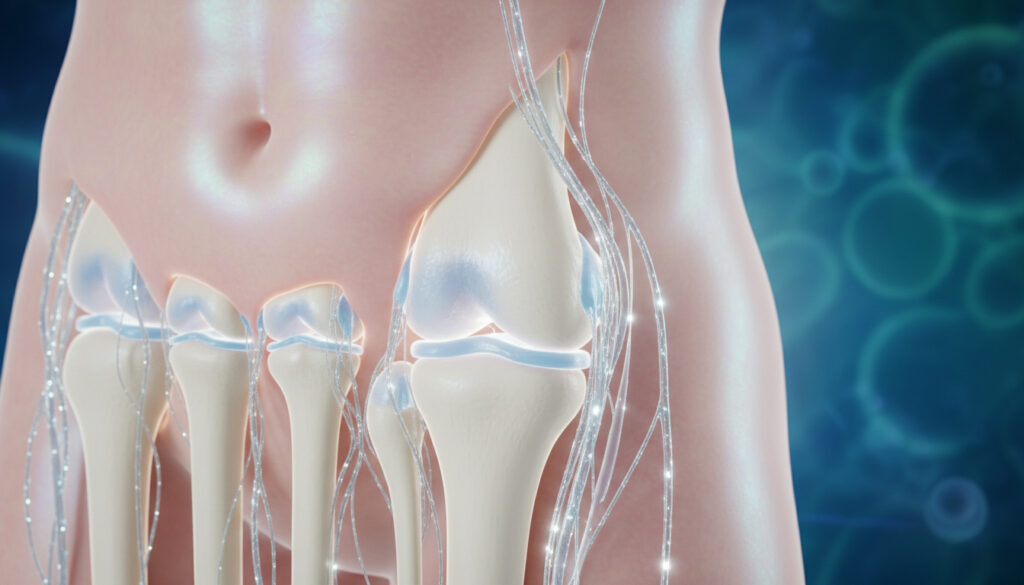
Skeletal and articular applications represent the most robustly investigated therapeutic domains for collagen supplementation. Clinical evidence strongly supports collagen’s efficacy for reducing joint pain and improving functional mobility, particularly among osteoarthritis patients.
Joint Function and Pain Reduction
Systematic reviews indicate that the majority of clinical studies report beneficial outcomes for articular health. Research documents reductions in joint pain, improved clinical parameters, enhanced physical mobility, and superior ankle function among supplemented populations.
Mechanistic studies demonstrate that collagen peptides stimulate chondrocytes to synthesize Type II collagen in a dose-dependent manner. These peptides function as chondroprotectors, promoting cartilage repair and extracellular matrix restoration within articular surfaces.
Bone Mineral Density
Randomized trials demonstrate increased bone mineral density specifically within the lumbar spine and femoral neck following collagen peptide administration. Twelve-month supplementation in postmenopausal women significantly elevated spinal bone density while increasing bone formation markers and potentially inhibiting degradation processes.
Collagen peptides demonstrate enhanced effectiveness when combined with calcium and vitamin D, showing positive synergies in bone mineral density improvements. Clinical protocols frequently incorporate vitamin C as an essential cofactor for hydroxylation reactions, alongside hyaluronic acid for joint lubrication and nicotinamide riboside for cellular energy support.
Collagen Benefits for Hair, Nails, and Gut
Investigation into collagen’s dermatological applications beyond skin and its gastrointestinal effects presents a more heterogeneous evidence landscape. Available data confirms certain biological interactions while highlighting significant research deficiencies.
Hair and Nail Integrity
Biomedical sources acknowledge collagen’s structural role in hair and nail health. The protein provides amino acid substrates necessary for keratin synthesis and follicle matrix development. However, current peer-reviewed literature lacks specific mechanistic studies or controlled trials quantifying efficacy for hair growth acceleration or nail strength enhancement.
Digestive Health Applications
The provided research corpus contains no specific information regarding collagen’s effects on gastrointestinal health, gut barrier function, or digestive tissue repair. Clinical investigation into these applications remains insufficient to establish evidence-based recommendations.
Practical Tips: Dosage, Timing, and Sources
Practical implementation of collagen supplementation encounters limitations regarding standardized protocols. Clinical authorities note that scientific research remains lacking for many supplement claims, including specific dosage recommendations and long-term safety profiles.
Commercial collagen derives predominantly from food industry by-products, though specific dietary sources rich in bioavailable collagen are not detailed in available literature. Manufacturers typically hydrolyze collagen enzymatically to create short-chain peptides that demonstrate superior absorption compared to native collagen proteins.
Collagen peptides consist of short, easily absorbed amino acid fragments resulting from enzymatic hydrolysis. Preclinical investigations utilizing radio-labeled peptides confirm pronounced accumulation in cartilage tissue, suggesting these fragments reach target tissues and stimulate local cellular synthesis.
Investigations examining bone biomarkers in postmenopausal women demonstrate varied results, with some physiological modifications occurring independent of collagen supplementation. Evidence indicates that body composition improvements require concurrent resistance training protocols.
How Does Collagen Production Change Throughout Life?
Endogenous collagen synthesis follows a predictable age-dependent trajectory, influencing tissue integrity and functional capacity across the lifespan. Understanding this biological timeline helps contextualize supplementation timing and therapeutic windows.
- Early Adulthood: Collagen production reaches peak levels during the 20s, providing optimal skin elasticity, joint resilience, and bone density.
- Decline Initiation: Synthesis rates begin decreasing during the 20s, marking the transition from anabolic to catabolic collagen balance.
- Progressive Degradation: Ongoing loss manifests as stiff joints, reduced mobility, and compromised bone strength without intervention.
- Postmenopausal Acceleration: Women experiencing menopause demonstrate particularly significant collagen-related bone density declines, creating opportune intervention windows.
- Clinical Reversal: Twelve-month supplementation protocols demonstrate measurable density recovery in spinal and femoral regions among older populations.
What Does Science Confirm Versus What Remains Uncertain?
Discerning established physiological effects from marketing claims requires careful examination of peer-reviewed evidence. The following comparison distinguishes validated outcomes from areas requiring additional investigation.
Established Effects
- Reduction in wrinkle depth and formation
- Increased skin elasticity and hydration
- Decreased joint pain in osteoarthritis
- Improved physical mobility metrics
- Enhanced bone mineral density (spine/femoral neck)
- Cartilage cell synthesis stimulation
- Osteoarthritis symptom mitigation
Uncertain or Unverified Claims
- Optimal dosage specifications for specific conditions
- Long-term safety profiles beyond 12-month periods
- Efficacy for gastrointestinal health applications
- Mechanisms for hair growth stimulation
- Nail strength enhancement protocols
- Universal efficacy across all age groups
- Weight loss or body composition effects without exercise
Understanding Collagen’s Biological Architecture
Collagen operates as the primary structural protein within mammalian connective tissue, exhibiting unique triple-helix molecular configurations that provide tensile strength and elasticity. Twenty-eight distinct collagen types exist, with five predominant forms maintaining human physiological function.
Type I collagen predominates within skin, bone, ligaments, and tendons, providing compressive strength and structural integrity. Type II collagen localizes specifically to cartilage matrices, offering cushioning and articulation support within synovial joints. Enzymatic hydrolysis reduces these large fibrous proteins into bioavailable peptides containing short amino acid chains necessary for endogenous collagen formation.
Research demonstrates that these peptides stimulate extracellular matrix macromolecule synthesis, induce chondrogenic proliferation, increase osteoblast activity, and suppress osteoclast-mediated bone resorption.
Expert Perspectives on Supplementation
Medical authorities and research institutions provide contextual analysis regarding collagen’s therapeutic potential and evidentiary limitations.
“Scientific research is lacking for most collagen supplement claims, requiring cautious interpretation of marketing assertions.”
— Cleveland Clinic Clinical Review
“Individuals supplementing with collagen show decreased osteoarthritis symptoms, such as knee pain and restricted movement, demonstrating meaningful clinical utility for degenerative joint conditions.”
— UC Davis Health, 2025
The majority of studies evaluating collagen’s effects on joint health reported beneficial outcomes, including reductions in joint pain and improvements in clinical parameters.
— Orthopedic Reviews Systematic Analysis
Key Takeaways on Collagen Benefits
Collagen supplementation demonstrates scientifically supported benefits for skin elasticity, wrinkle reduction, joint pain management, and bone density maintenance, particularly among postmenopausal women and osteoarthritis patients. While hydrolyzed peptides exhibit bioavailability and tissue-targeting capabilities, significant uncertainty persists regarding optimal dosing, long-term safety, and efficacy for hair, nail, and gut health applications. Consumers should evaluate products critically, recognizing that dermocosmetic solutions and nutritional supplements serve complementary roles within comprehensive wellness strategies.
Frequently Asked Questions
Are there side effects of collagen supplements?
Current research has not established comprehensive side effect profiles or long-term safety data. Available studies do not detail adverse reactions, though individuals with specific allergies should exercise caution regarding source materials.
Does collagen work for everyone?
Efficacy varies significantly by age, baseline collagen status, and health conditions. World Health Day initiatives emphasize that nutritional interventions produce individualized results based on genetic and metabolic factors.
Can collagen supplements help with weight loss?
Research indicates improvements in body composition and fat-free mass occur only when collagen supplementation combines with resistance training protocols. No evidence supports independent weight reduction effects.
What foods naturally contain collagen?
Specific collagen-rich food sources are not detailed in available peer-reviewed literature. Commercial supplements typically extract collagen from food industry by-products through enzymatic processing.
Is collagen effective for arthritis pain?
Strong evidence supports collagen’s efficacy for osteoarthritis symptoms, particularly knee pain and movement restriction. Studies demonstrate significant improvements in joint pain among women with moderate knee osteoarthritis.
How long until collagen supplements show results?
Clinical trials measuring bone mineral density require twelve-month supplementation periods to demonstrate significant improvements. Dermatological benefits may manifest within shorter timeframes, though specific timelines vary by outcome measure.
More related posts
 Queen Charlotte: A Bridgerton Story – Fact vs Fiction
 Mississippi DEI Ban Blocked by Federal Judge
 USD to COP: Convert Dollars to Colombian Pesos (2025 Rate)
 Which Special Day Is Today – World Health Day on April 7
 National Lampoon’s Christmas Vacation – Cast, Plot, Trivia Guide
 Cleveland Cavaliers vs Trail Blazers Match Player Stats
 Greater Than Less Than – Symbols, Mnemonics and Examples
 Saie Glowy Super Gel – Multi-Use Clean Glow Review